On 24 May 2022, there was a spree killing at Robb Elementary in the small Texas town of Uvalde. It made national headlines, not only because precious children were lost, but because the media (and politicians jumping on the band wagon, and even many police officers who heard of it) accused the police of letting those kids die. Responding officers, according to the video footage, allegedly had “Maverick won’t engage” syndrome. The whole story, as always, is more complicated than we can get from 20-second sound bytes, or politicians and lawyers playing the blame game.
The way it was covered in the news led many parents to feel they needed to respond to schools themselves, since the narrative promulgated by the media was that, nationwide, “craven, cowardly law enforcement officers will not be there for our kids.”
Nothing could be farther from the truth, even though there were many mistakes made at Robb Elementary, by the leadership, by the responders, by the teachers, and by administrators.
Like many schools, Robb had a written active shooter plan and protective policies, but they wrote that plan to check a box, and failed to adhere to their own security policies (Robb Elementary Investigative Committee Report [REICR], p. 14). Plenty of blame to go around, even though almost all of it fell upon the police who responded, and none of the blame landed on the one person who could have saved all those children: the scumbag tho took it upon himself to murder them.
There were also several things done right in Uvalde, although you never read about them nor saw them on your news feed.
In November of 2023, about a year and a half after the spree killing at Robb, I paid my respects to the parents of a former partner, Travis Attaway, who had drowned on duty in the Rio Grande. Robb Elementary was just a ways down the road from his hometown, so I went to Uvalde and spoke with some people who had been there, to learn what I could.
Here’s a short version of what went down on at Robb on 24 May 2022:
The killer murdered his grandmother and stole her truck. He crashed it into a wide, empty concrete canal about 100 yards from the west side of Robb elementary. Employees of the funeral home across the street to the north of the crash, one of whom was an EMT and saw it from her office window, began running over there to help. The killer reached in the truck and unlimbered a rifle at the funeral home employees.
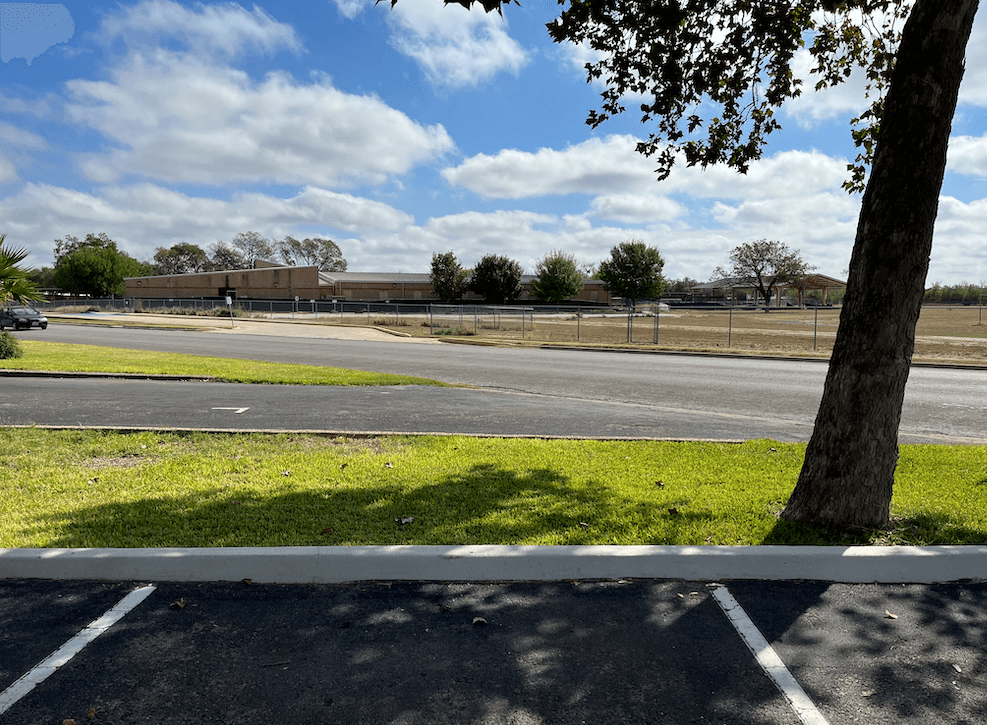
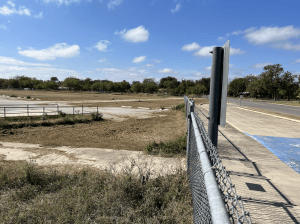
View of the Robb Elementary schoolyard from the funeral home parking lot. The killer crashed the truck he stole into the concrete ditch on the right, and shot at the funeral home employees who were about where I was standing when I took this photo.
They had thought they were running to his rescue. Despite their being well within the effective range of an AR, he missed, because (said it before, and I’ll say it again) these idiots who shoot up schools are NOT Navy SEALs. The would-be rescuers retreated back into the funeral home. He threw his gear over the fence and walked toward the school.
Rifles are LOUD. Coach Yvette Silva was in the schoolyard, heard the shooting, and saw the shooter jump the fence.
Start Taking Perimeter Security Seriously
That fence around the Robb schoolyard, like many around elementary schools, was designed to keep children IN, not to keep killers, kidnappers, and child predators OUT.
“We don’t want kids to feel like they’re in a prison” is the tired old bleat for not having better physical safeguards around our most precious resources, our children. A school fence doesn’t have to be topped with concertina to at least slow down a killer.
We’re not asking for this.
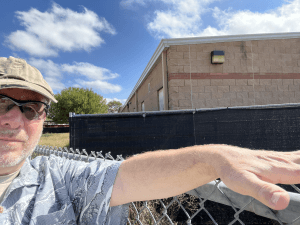
But even in my 60s I could get over a 5-foot fence. We need to stop giving killers access to our children for free. At least make them work for it.
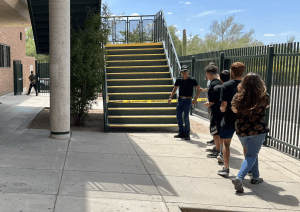
This type of fence is much harder to climb. Of course, it’s all for naught if we leave the gate open. Notice the screened pushbars on the gate allowing it to be locked from outside but enabling escape from inside. Image from an Active Shooter Workshop for educators
High School shooters are almost always students (or recent students), and are usually right there, inside the building (cafeterias are common), when the shooting starts. Elementary schools tend to be shot up by outsiders, and the killing usually starts on the playground or at an exterior door (Monk, First 30 Seconds, pp. 65 – 69). See Patterns of Spree Violence in Schools for more.
Coach Silva heard the rifle shots across the school yard and saw the killer at about 11:28 am local time. She immediately notified the Robb administration via radio and ushered some third graders inside.
“Coach Silva to office, somebody just jumped over the fence and he’s shooting.”
–REICR, p. 41
When the shooting started, the west door to the West Building at Robb had been propped open. The people rushing inside kicked the rock out of the way and let the door shut, but did not check to make sure the door was locked. It was supposed to be at all times, but it was not on that day (REICR, footnote 132).
As I said, according to one eye witness that I spoke with, the killer WALKED, he did not run, to the school. That gave the people in the school plenty of time to bunker down. But the school employees failed to lock any of the three outside doors to the building the killer attacked (the West Building).
View from the northwest corner of the West Building (the one the killer entered). It’s a long way from the ditch where he first started shooting, by that tree-line, across this school yard, to the school. Previous photo was taken by that tree on the right; the funeral home is off-camera to the right. Safariland CADRE Dispatch image by George H.
Principal Mandy Gutierrez tried to initiate a lockdown via her Raptor cell-phone notification system, but did not have a good internet connection. She failed to follow up with any notification via the school’s intercom. She did instruct custodian Jaimie Perez to ensure the doors were locked. The doors to the classrooms had to be locked with a key from the outside, and were by policy supposed to be locked at all times, but that policy was largely ignored.
Perez had heard Coach Silva’s radio warning and was already on it, checking door locks. Principal Gutierrez possessed a master key, but locked down in her own office and did not assist in making sure the classroom or exterior doors were locked. Later she sheltered in the cafeteria (REICR, pp. 44 – 45).
At 11:33, five minutes after the unmistakable first rifle shots, the killer entered the school through the unlocked west door (the upper left end of a T-shaped pair of hallways). The lock would not have stopped him, but it would have bought them more time.
Locking the exterior and interior doors ultimately may not have been enough to stop the attacker from entering the building and classrooms. But had school personnel locked the doors as the school’s policy required, that could have slowed his progress for a few precious minutes—long enough to receive alerts, hide children, and lock doors; and long enough to give police more opportunity to engage and stop the attacker before he could massacre 19 students and two teachers.
–Robb Elementary Investigative Committee Report, p. 6
The lock to 111 was capable of locking, but it was not fully operational and required extra effort to lock. The staff had a culture of not bothering to lock it, and of “noncompliance” with locking doors in general (REICR p. 6, 26 – 27).
Pre-Strike Intel and Recon
The killer may have had information that the door to room 111 did not lock, because we see on the security camera video from the north hallway that he walked past the doors to classrooms 132, 131, and 116, proceeding DIRECTLY to the vestibule that had doors to classrooms 111 and 112. Conspiracy theorists fixated on that behavior as an indication that it was a “staged, inside job.”
But a few days before the attack, while playing video games with his cousin’s son, then a student at Robb Elementary, the killer had asked the boy probing questions about the school, their schedule, and the cafeteria (REICR, p. 38). He may have found out about the room 111 lock, and the lax enforcement of locking policies in general, then. Or maybe he had been in that particular classroom when he was in 4th grade. Maybe classroom 111 held some other special meaning to him. There’s only one way to find out what was going through his mind: if I don’t wake up some morning and find myself in Hell, I suppose I can ask him.
He is believed to have also conducted pre-strike reconnaissance from outside the school on 23 Mar 2022, when a person dressed all in black (the killer was in the habit of wearing black) was seen “canvassing Robb Elementary” (REICR, p. 35).
4th grade teacher Arnulfo Reyes, who was in room 111, testified that he knew the door was broken and would not lock (REICR p. 28), and said he did not recall getting any lockdown alert, although other teachers in the school (including the adjoining classroom) did.
4th grade teacher Jennieka Rodriguez briefly stepped outside her door to ensure it was locked. When she did, she and Irma Garcia looked at each other. Ms. Garcia was locking the door to room 112, which adjoined room 111. One of the surviving students from room 112 also reported witnessing Ms. Garcia checking the lock (REICR pp. 46 – 47).
The bad guy fired into room 111 from the hallway outside. Then he entered room 111 and fired over 100 rounds over two and a half minutes, killing and wounding many in room 111 and the adjacent 112. He must’ve reloaded at least twice. Those kids were shot before the first law enforcement officers entered the building. One of the bullets went through walls and struck Mrs. Avila, a teacher in room 109.
The killer then bunkered down in a ballistically resistant (cinder-block and brick-lined) book closet, aimed his gun at the door, and waited to ambush responding officers when they came through the door (ALERRT AAR, p. 12).
See “Asymmetric Evacuation, Part IV: Robb Elementary” in the Safariland CADRE Dispatch, or the REICR, pp. 51 – 52, for a detailed timeline of what happened next.
The short version is, officers entered the building through the West and South doors within seconds of each other. A few seconds later, the killer’s initial barrage of gunfire in rooms 111 and 112 ended.
The saw the casings, they smelled the smoke. There was no more gunfire “stimulus” to run to, and there were no screams to follow, as the teachers in other classrooms were keeping their kids quiet.
They saw holes in the door to room 111. There was a glass window in the door. When they reached for the door knob of room 111, he killer sprang his ambush too soon, sending bullets at them through the door.
The officers backed off in search of a better option. I have run to the sounds of gunfire in progress, and I got paid to serve warrants for decades. I’ve been through some doors. But I’m not sure I would have gone in at that point. Search your feelings, Luke: if you have any sense, you probably would have backed off too, till you could come up with a better plan. None of their vests would stop 5.56x45mm, and they had seen 5.56m casings on the ground.
Not many “better” plans materialized immediately. For police officers, “active shooter response” is a no brainer: run to the sounds of the shooting and contain the threat, accept the perpetrator’s surrender, or, if the killer is not so inclined, put him down. They had him contained in a pair of adjoined rooms, and as far as anyone could tell, their active shooter had turned into a barricaded hostage taker. Dealing with barricaded hostage takers is much more complex than active shooter response.
Officers wound up at the south end and the north end of the hall with the doors to rooms 111 and 112 between them. They remained there for about an hour.
The West Building at Robb Elementary. Image from the REICR.
Which leads us to the first take-away:
What would the teams at each end of the hallway have done if the bad guy had come out shooting?
The presence of the other team at the opposite end of the hallway would have precluded anyone with any sense from firing at him. If they had, they would have nailed each other with crossfire.
*****
Crossfire in San Jose
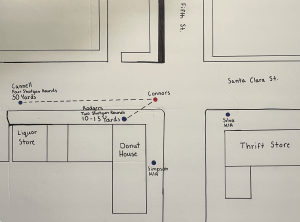
On 20 Jan 1989, an unarmed man (red dot in the diagram below) murdered Officer Gene R. Simpson with Simpson’s own gun. Officers converged on the killer from different directions and put him down.
When the smoke cleared, San Jose, CA Officer Gordon A. Silva was also down. Silva’s autopsy revealed two wounds to Silva’s legs that had probably been fired from the gun the killer stole from Simpson. But the fatal round to Silva’s abdomen was 00 buckshot from the shotgun of another officer 50 yards on the opposite side of the killer.
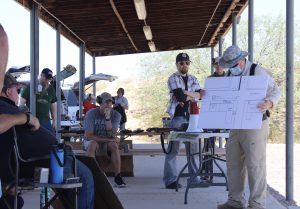
Showing Shotgun students that diagram of the San Jose Blue on Blue. My daughter drew it based on an illustration in the San Jose Mercury News. I had received the Mercury News article as a handout from a Shotgun Instructor course I took at Gunsite.
At 50 yards, a typical buckshot pattern is four feet wide.
How does this apply to you, the responsibly armed citizen?
What if you hear a commotion, run and get your gun, and accost the killer holding your daughter hostage in the hallway–only to have other concerned family members appear in the same hallway, on the opposite side from the kidnapper?
That could be good or bad, but many of the potentialities are bad. On the plus side, the ones behind the hostage taker could sneak up behind him while you distract him.
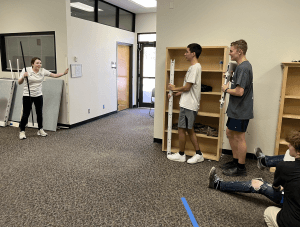
The door to this room (down that short hallway) is glass, and even if locked would not keep a killer out for long. The educator in the white Polo (on the left) in an Active Shooter workshop instructed the role-player “students” on the right to NOT engage the killer, should he breach their locked door, till AFTER she distracted him. Then, they were to jump him from behind. THAT’s leadership.
An upward angled shot to his head MIGHT have minimal risk to those on the other side. But the closer you are, the more upward angle you can get. From opposite ends of the hallway, vertical displacement might not have made much of a difference.
Using a green laser, a student learns that upward angled shots (in this case, to “Cellophane man’s” head) may clear innocents behind.
But if the hostage taker does know they are there, your chances of getting a clear shot on the hostage taker are much lower if there are other good guys in the hallway behind him. There are some niche techniques we can teach you for taking down bad guys in long narrow spaces, such as pistol inquartata, but they are fraught with risk for those on the other end of the hall.
A jacal near Arivaca, Arizona
Arivaca sits in brushy, rolling hill country about 40 miles WNW of Nogales, Arizona. Visitors find it to be quaint and picturesque. When I worked narcotics, we saw Arivaca as more like Mos Eisley spaceport on Tatooine: “a wretched hive of scum and villainy.”
The Sinaloan cowboys occasionally seen in town wore Stetsons, and tourists might’ve mistaken them for local ranchers. Well, they were into agriculture of a sort. But their hats were not sweat-stained, and their expensive boots were awfully shiny. We used to joke that there were only three people in Arivaca who were not in the drug trade, and those three were retired drug smugglers.
After taking down yet another stash house in Arivaca, we developed intel about the location of a jacal (“ha-CAHL,” a small, rustic shack) in the boonies that had more dope. We found it and approached it from the side. As we got closer, I swung around to the right and moved ahead so that if anybody in the jacal started shooting, our return fire would pass through the shack at right angles, like the sides of an L.
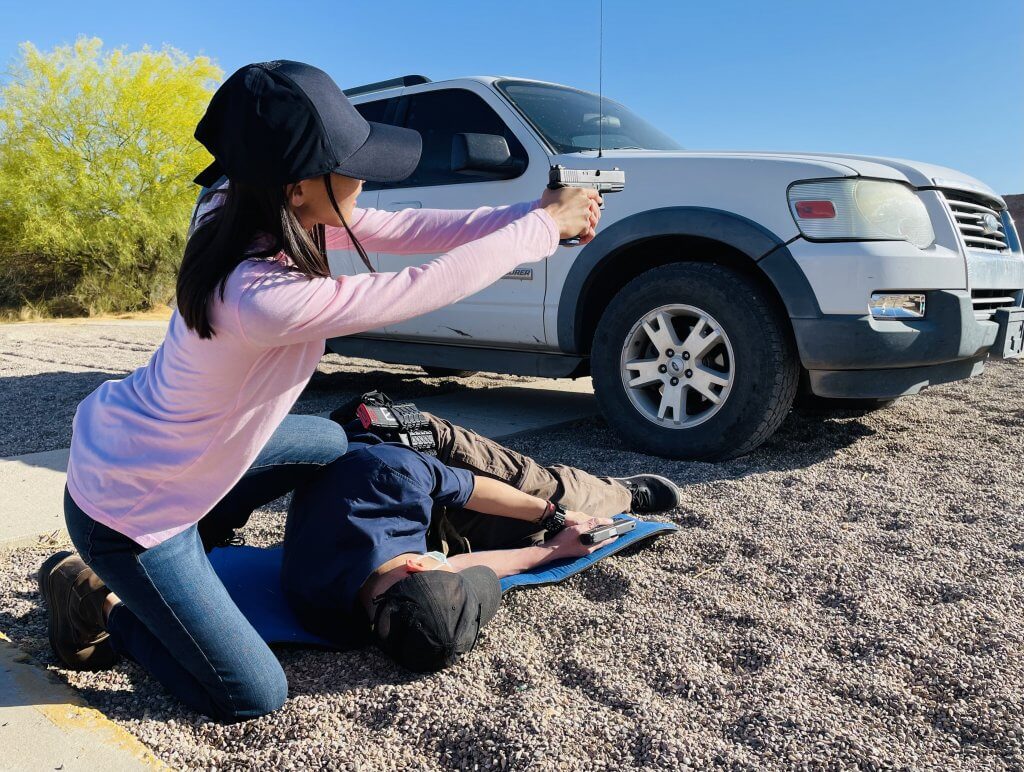
Using barrel inserts that prevent the chambering of ammunition, students in a Defensive Pistol Skill Builder class practice getting an assailant in an “L.”
My initial plan was to be 90 degrees off of our approach, to the right of the jacal.
Our teammate Eric (it was his case) said “Watch your crossfire,” meaning “slow down a bit and don’t get on opposite sides of that jacal.”
My movement had been intended specifically to avoid crossfire. But when I broke off, another teammate mirrored my movement off to the left (there was no “street” side out there, but if you wanted to call our approach side the “Alpha” or “number one” side, he was moving to the Bravo or number two side, and I was moving toward the Delta or 4 side).
It’s easy to get tunneled-in on a potential threat. After Eric’s heads-up, I caught the other teammate’s movement out of the corner of my eye and slowed, eventually reversing to match, so our approach was like a V (he was toward the 1/2 corner and I was toward the 1/4 corner of the jacal).
Eric was on the Special Response Team, but one does not need to be a SWAT operator to recognize potential crossfire. Any Army corporal who’d led a fire team for any length of time could’ve figured out how untenable the two positions on opposite ends of the south hallway of Robb Elementary were.
At Uvalde, a leader with a modicum of tactical acumen would have sent one of the teams facing each other in the hall somewhere, anywhere, else–ideally the south end team, because the team at the north end of the hallway had the east-west hallway for staging (they set up a casualty collection point in the east side of the north hallway). But which team would have left wasn’t nearly as important as that one of them should have. Neither did.
For your purposes in hostage rescue, an L is a capital L, not a lower case l. You can’t be on opposite sides of your hostage taker. He must be in something approximating a 90 degree angle between you two.
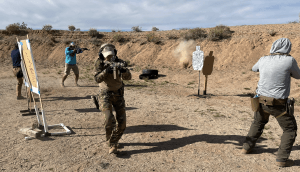
Team entries and hostage rescue are fraught with danger for all involved. These highly trained shooters participating in advanced hostage rescue training must be mindful of crossfire and shoot-through issues. Rescuers 1 (grey shirt on right) and 2 (blue shirt) must train to maintain that 90 degree angle–this looks like it could be approaching 80 or even 75 degrees–resisting the temptation to move farther downrange to get a better angle on the tan hostage taker target. If they kept moving downrange, eventually they’d be squaring off on each other through the hostage target. What you see here is the absolute minimum off-angle to try this, and the rescuers facing each other in the South Hallway at Robb Elementary didn’t have nearly that much off-angle. Rescuers 3 and 4 through the door must also be mindful of muzzle direction as they turn to dig the hard corners of this simulated room.
Chief Arredondo, the officer who was, by school district policy, supposed to be in charge at Robb Elementary, could have sent the south team around the east side of the building to try to dominate the room from the outside (or at least gather intel) through a window. Somebody may have tried that, but been unable to see in. Here is some blatant conjecture that may explain why Chief Arredondo and the others with him might have stayed in the south hall:
Chief Arredondo may have lacked tactical acumen. He had roughly 30 years in law enforcement, but some people have 30 years of experience and others have three years of experience 10 times over.
The first aspect of tactical acumen he should have possessed was the knowledge that someone must take charge in these situations. SMSgt Ferguson, the finest small-unit tactician I ever had the privilege of training under, used to tell us junior NCOs “When in charge, be in charge.”
Chief Arredondo had signed off on a policy stating that he was supposed to be in charge. That should have meant establishing the ICS, Incident Command System, and running the show, probably from outside the building.
He had wanted to “lead from the front,” and that is admirable, but he wound up in the south end of that hallway and was so tunneled-in on that alcove he had less perspective on the broader picture. If he had been outside and drawn a T-shaped diagram on the hood of a cruiser with a grease pencil, he could easily have seen that some of the little stick figure cops in the diagram needed to be moved.
Because his knowledge and training had not kept up with the times, he apparently thought he was dealing with an old-fashioned barricaded suspect.
It had, in fact, turned into a barricaded hostage situation, but with a major difference from when the old “sweat and starve him out” tactics for barricaded suspects with LIVE, UNINJURED hostages were developed. The suspect did not have hostages, per se. He had dead and dying victims. When a robbery goes bad and a suspect barricades himself with hostages, his goal is a negotiated escape. The killer at Uvalde had a different goal: to maximize carnage. The longer it went on, the more of the kids he had already shot bled out and died.
The killer’s only remaining wish in life was to kill as many cops as he could before he went down. Any wounded “hostages” still living were not hostages to the killer.
Those dead and dying children were bait.
But the police weren’t biting. He had sprung his trap just a bit too soon to catch them in the fatal funnel of the doorway, and they had backed off.
Body Recovery is not Rescue
On 07 July 1998 I was crouched in a makeshift bunker we had made by ramming patrol vehicles together around a severely wounded agent, Susan Rodriguez. One bad guy was down but we didn’t know where his two alleged accomplices were. Another agent, Ric Salinas, lay facedown outside our bunker. He had been shot in the head and had exposed brain matter.
I liked Ric and would’ve done anything for him when he was still alive. But Ric had already met his Maker. There was no point in risking anybody’s life to protect his body; his soul was no longer using it and it was only useful then, exactly where it lay, as evidence for later investigators. Ric would not have wanted us risking our lives for his dead body. When my time comes, don’t anybody risk your lives for mine, either.
I used to teach downed officer rescue to special agents and taskforce officers. We borrowed a phrase from our firefighter friends, who say
Risk little to save little.
Risk a lot to save a lot.
We will take considerable risks to save our partners who might be savable. We strictly admonished our agents not to risk their lives to recover any bodies that are clearly already dead.
Practicing downed officer rescue. We wouldn’t do this if the “wounded agent” represented by the blue manikin was already dead.
The vast majority of the students & teachers in rooms 111 and 112 of Robb Elementary–perhaps all, as far as the officers in the hallway knew–were already dead. I’m not saying the officers in that hallway had written them off as a lost cause; rather that they had contained the situation and that it would have been irresponsible to go charging in there while the building was full of other, unwounded, students who could get hurt or killed by all the bullets that would inevitably be flying through the walls when they did.
Chief Arredondo was holding out for breaching equipment (the pre-Columbine “call for SWAT” plan), rifle rated body bunkers (USMS provided at least one rifle rated body bunker about halfway through the standoff), and the keys to the door. Apparently he did not know it would not lock, and he did not want to be standing in front of that door trying to breach a lock when bullets came through it again. The Robb Elementary principal who had the keys was hiding somewhere else. I didn’t see any images of her in the south hallway, handing off the keys. As far as I can tell, that never happened.
At 11:40, and again at 11:44, the killer fired a single shot, so they would view him as an “active” killer and come into the KZ (kill zone) of his ambush. He did not fire again, till 12:21 (ALERRT AAR, p. 20).
I spoke with someone who was fairly high up in the Border Patrol about Uvalde. He was privy to more info than I am, much of which he did not share with me (I’m basing most of this on the report by the Texas House of Representatives, as well as the ALERRT report, and my interview of an eyewitness who worked at the funeral home). But my former partner from the BP believed the killer was shooting through walls at the sounds of people he heard in adjacent rooms. In that respect, the killer was still “active.” When a killer is actively assaulting people, the national best practice since Columbine has been, and remains, to run pell-mell to the sound of the guns.
Which brings up another lesson paid for in blood by the students and teachers of Robb elementary. It is not a new lesson, but it is becoming more important as the nature of the threat evolves:
In hostage situations, just as Miyamoto Musashi said in the 1600s about fighting multiple threats,
“Waiting is bad.”
What used to be the standard practice for hostage situations, bore him to death and starve him out, is now often outmoded. Every second you delay increases both the killing and the dying (at Robb Elementary, the killing was mostly done before the cops arrived; it’s likely that several of the wounded died over the next hour since they were unable to get timely medical treatment).
This is why I say that if you are armed, responsible, and competent, you should take the shot on a hostage taker or active killer as soon as you can get a clear shot.
Having an armed friend who is also well trained on V to L tactics and a competent shot vastly increases your opportunity to get that clear shot.
*****
The Asymmetric Evacuation of Robb Elementary
Hundreds of officers, deputies, troopers, and agents responded to Uvalde from all over the region.
To their credit, the on-scene officers, deputies, and agents you did NOT see on that hallway security camera started evacuating the other classrooms through outside windows during the 70+ minutes they had the bad guy contained in room 111.
This is called asymmetric evacuation. They could not bring the kids out through the warm zone of the hallway that could turn hot at any second.
Nor could they leave them “sheltered in place,” because their places were not shelter from the coming gunbattle to retake room 111. The exterior walls of the West Building at Robb were brick, but the interior was drywall.
Instead, Chief Arredondo ordered the rest of the students and teachers evacuated through the exterior windows.
While the Texas legislature’s investigative report outlines Arredondo’s reasoning regarding the drywall of the contested hallway vs. the cover of the exterior brick, and acknowledged Arredondo’s instruction to asymmetrically evacuate, these are mentioned almost as footnotes and not praised in any way as sound tactical reasoning or a good plan that would necessarily be time consuming. They never failed to excoriate the Arredondo’s “indecision and delay” instead.
“Although the encounter had begun as an “active shooter” scenario, Chief Arredondo testified that he immediately began to think of the attacker as being “cornered” and the situation as being one of a “barricaded subject” where his priority was to protect people in the other classrooms from being victimized by the attacker.
With the benefit of hindsight, we now know this was a terrible, tragic mistake.”
–REICR, p. 52
As far as I can tell, Chief Arredondo’s order, about 6 minutes after they made entry, to asymmetrically evacuate the rest of the students from the building before the inevitable confrontation with the suspect, was NOT a mistake. It was probably the wisest, best decision Chief Arredondo made that day. Yet those politicians (what Clint Eastwood’s “Gunny Highway” would describe as “a committee of congressmen who, asshole to asshole, couldn’t make a beer fart in a whirlwind”) painted it as pusillanimous delay, while only grudgingly admitting that they had an air-conditioned, after the fact, birds-eye view of the incident. Arredondo saw the situation over the sights of his pistol, whether or not he should have.
The police stashed the kids at the funeral home, and told the people there to not open the doors for anybody not in a uniform. I know this because I spoke to people who were there.
*****
Resolution & Unqualified Opinions
I have been through a few doors. And I have some knowledge of (and experience with) small unit tactics.
But I did not visit Robb Elementary in Uvalde until a year and a half AFTER the incident. I did not talk with everybody, or even a majority, or even more than a few people who where there when the unthinkable happened. Take anything anybody who wasn’t there when it was happening, including me, tells you about Robb Elementary with a grain of salt.
Nothing in this article is intended to second guess the actions (or inactions) of brave responders who were trying their level best to make a horrible situation less awful (even if some of them thought the smartest thing was to do nothing and wait him out), under tremendous pressure, without the benefit of 20 / 20 hindsight.
Refer to Norm the Navigator for more about talking smack when one’s opinion is unqualified. It chaps my behind when I hear talking head reporters (or politicians) who have never put their life on the line for anybody talking about what cops could or should have done.
The first officers on the scene saw the empty cartridges by the door and KNEW they were facing a rifle. As I mentioned before, they did not have rifle-resistant armor plates for their body armor, but they attempted to enter the classroom anyway. When they took rifle fire through the door, they backed off, as any sane person would have done. They called for keys, and breaching equipment so they would not have to taking fire forever the next time they had to stand in front of that door. The Texas legislature’s investigative report arrived at numerous preliminary conclusions. Here’s one such gem (“Factual Conclusion 3.t”):
While officers acted on the assumption that the doors to Rooms 111 and 112 were locked, as they were designed to be, nobody tested that assumption.
–REICR, p. 76
The REICR is mostly a well-balanced analysis of the facts, and Conclusion 3.t is indisputable. But the question is, after taking fire through that door, would you have gone up there and rattled the doorknob? Me neither. I doubt very much that any of those legislators would.
Maybe I’m selling their courage short. But there is such a thing as “tombstone courage,” and my mentors, be they Army PNCOC instructors with 5th Special Forces patches from Vietnam on their combat sleeves, or officer survival instructors at the three police academies I attended, always took great pains to train tombstone courage out of us.
You can’t help anybody if you are dead.
The legislators who wrote that report probably got most of their training about how to approach a door from law enforcement procedural dramas on TV, where the actors pretending to be cops pull up right in front of the house with their lights on, slam the doors loud enough to be heard three blocks away, and then stand directly in front of the door as they knock. When they breach, the door always flies open with just one kick or strike of the ram.
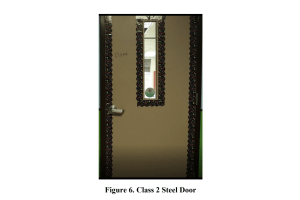
The outward-opening classroom doors in Robb Elementary were steel. The door frames were steel, which is considerably more difficult than a wooden door jamb to breach (ALERRT AAR, p. 10 – 11).
Image of a door at Robb Elementary from p. 11 of the ALERRT AAR, reproduced here for lifesaving, educational purposes.
Ever tried to kick a metal door that was latched shut? It hurts your foot, and the door is not even annoyed. I’ve actually breached doors with rams and Halligan tools. They sometimes take a long time to give way. That’s time the breacher is in front of the door.
The classroom walls were drywall (gypsum board) and could have been breached for firing or observation ports with a simple sledgehammer. There is zero doubt anyone doing so would’ve taken fire. This was not (to my knowledge) attempted at Robb, nor should it have been unless the wall breacher was protected by another officer with a ballistic shield.
Ballistic shields come in different ratings. The most portable are typically IIIA, which will stop most pistol and some slower moving rifle rounds. III is a higher level of protection than IIIA, and stops more rifle bullets, but not all. Level IV plates and armor would have stopped what the killer was shooting at Robb Elementary. The problem with those Level IV shields is, they are very heavy.
I used to work with a breacher’s breacher. The name on his birth certificate was Eric, but we all called him “Thor,” for reasons you can probably surmise. He could handle one of those heavy Level IV shields; not many can. But if I was there with Thor, I’d have put his talents to use doing what he does best: breaching. Holding a shield is for short guys like me.
Ballistic shields (I’m not sure what protection level) started arriving in the Robb Elementary hallway at 11:52, about halfway through the standoff.
Another thing that might have been done at Robb was to explosively breach the door, or to use “water impulse” charges (or even sledge hammers) to blow observation / gun ports in the wall between the hallway and rooms 111 & 112. This had been done with limited success (police saved one of the two remaining hostages) at Platte Canyon High School on 27 Sep 2006 (Giduck & Bail, Shooter Down, p. 113). But the Jefferson County (Denver) Regional SWAT team responding to Bailey, Colorado had all day to prepare their final assault before the rapist’s self-imposed deadline of 4:00 pm. The officers in Uvalde took a fraction of that time, just over one hour, to go in. They only took a little over two minutes after a sledge hammer arrived to set their Halligan.
The Platte Canyon hostage taker had been motivated by rapine; he molested high school girls and released them one at a time over the course of an entire day. In contrast, the Uvalde killer had two priorities:
To maximize the carnage.
To kill as many responding police officers as he could.
After the other kids were evacuated from the rest of Robb Elementary, there was nothing for it but to enter the fatal funnel of the kill zone they KNEW the killer had prepared for them. The longer they delayed entry, the more of his victims bled out.
I’m not being an apologist here. My heart and prayers go out for every single one of those victims and their relatives. But understand this: those victims include every single one of the officers who responded, who will never, ever be able to un-see or un-smell that horror. For those of you who have had the privilege of never being up to your elbows in human gore, puddles of blood have a metallic smell that won’t come out of your nostrils even after several showers.
Those victims also include the selfless employees at the Hillcrest Memorial Funeral Home across the street from Robb Elementary, who tried to rescue the killer after he crashed his truck into the canal, and got shot at for their efforts. Then they sheltered and protected the evacuees. Later, they had the onerous duty of preparing the dead for their funerals.
Internet whack jobs and conspiracy theorists have gone so far as to claim Robb Elementary was some sort of false flag operation, or even that it was “fake news” that never happened. As a career criminal investigator (federal equivalent of a detective), I’ve been lied to a few times. I looked into the eyes of the brave Hillcrest employee who witnessed the truck crash through her office window, who tried to help, who got shot at, and then watched the killer walk to the school. She wasn’t lying when she spoke of the tiny, broken bodies they had to prep for burial.
I had some issues with the way the Border Patrol did business when I worked for that agency, but I have rarely been so proud to be a former Texas Border Patrol agent as when I learned that the ones who finally broke the deadlock, who cowboyed up and did a direct frontal assault right through that door (one of whom got winged in the head), ending the killing in Robb Elementary, were Patrulla Fronteriza.