In World War One, bayonets were long–practically short swords.
17-inch bladed Australian1907 pattern bayonet on topmost rifle (a SMLE) is typical of the lengths found in WWI. The socket mounted, double edged spike bayonet on the US Model 1881 immediately below that is just as long, and effectively converts that trapdoor Springfield into a pike. Other bayonets in this photo are, top to bottom: side-folding blade bayonet on a Vz. 52 (right); socket mounted, cruciform spike bayonet on a Mosin-Nagant 1891/30 (left); Mauser Kar 98 blade bayonet (left); double edged blade bayonet on a Swiss K-31 (left); under-folded spike bayonet affixed to a Carcano carbine (right); side-folding spike bayonet affixed to a Chinese Type 53 (left). Replica Zulu iKlwa on lower left needs no attached rifle to be a fearsome instrument of war.
Bayonet collectors refer to those older, longer bayonets as “sword bayonets,” and newer, shorter bayonets as “knife bayonets” or “bayonet knives.”
The M1905 bayonet for the US M1903 Springfield rifle had a 16 inch blade, with a wide, square fuller. It was made from 1906 to 1922.
M1903 (right) next to its cousin, the Mauser Kar 98 (left), on the Upper Range Deck at Thunder Ranch.
Despite the millions of bayonet toting infantrymen who were mown down between the trenches by machine guns and artillery during World War One, the bayonet remained an important part of US military doctrine between the world wars. So much so, that the business end of the M1 Garand, including the width of the barrel, and both the vertical and longitudinal distance to the bayonet lug, were designed specifically to accept the Army’s existing stockpile of M1905 bayonets.
Production of the M1905 resumed again in the months after Pearl Harbor. Collectors sometimes call those “M1942s,” although the US military still called them M1905s.
When US troops invaded (Vichy French) North Africa, some had M1903 bolt action rifles and some had the newer M1 Garand semi-automatic rifle. On 10 Nov 1942, soldiers of the 9th US Infantry stormed the Sebou River kasbah with M1905 bayonets affixed to the rifles, regardless of which rifle was in their hands (Martin K. A. Morgan, “Guns of Operation Torch,” American Rifleman, Nov 2022, pp. 51-52).
The bayonet designed for the M1903 Springfield remained front-line equipment, even after the M1903 rifle it had been designed for was rendered obsolete.
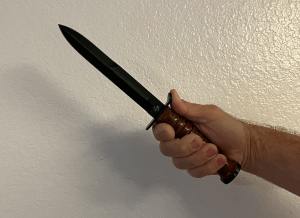
In World War Two, soldiers were sometimes fortunate enough to ride to battle in something other than LPCs (leather personnel carriers). Many of the existing M1905 blades were hacked down to 10 inches by armories to make them more convenient to hang off the belt in and around a truck, a half-track, a C-47, or a glider. The 10 inch bladed version of the M1905, whether cut down from an original or made with a 10 inch blade (starting in 1943), was designated the M1 bayonet (not to be confused with the M1 Garand, the M1 carbine, or the later M1 Abrams main battle tank).
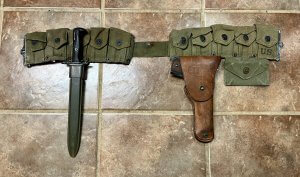
The M1 bayonet on the left side of this web belt (with pouches for Garand clips) doesn’t hang much lower than the M1911 .45 on the right side. Pouch to the right of the pistol holster is for a field dressing (bandage). These artifacts are from the collection of retired Army Ranger Max M.
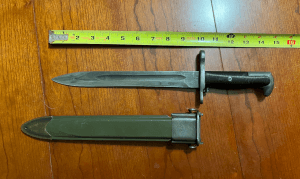
The tips of the cut-down M1905s came in different shapes, as different armories found various creative solutions to deal with the original M1905s long fuller, which exceeded the length of the shorter M1 blade.
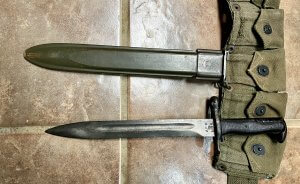
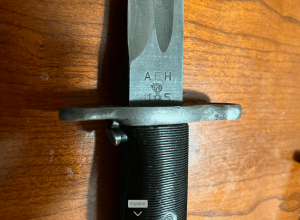
As you can see from the initials on the ricasso, this 10″ bladed M1 bayonet was made by American Fork and Hoe, a conglomeration of farm implement manufacturers based out of Geneva, Ohio. From the collection of Max M.
M1 bayonets made during World War Two had narrower, rounder fullers, as well as plastic grip panels (the original M1905 grips were wood).
Rounded ends of the fuller tell us this M1 bayonet (also made by American Fork & Hoe) was made during WWII. From the collection of Intel Officer Eric Y.
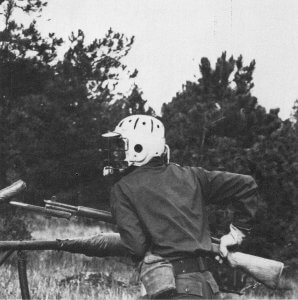
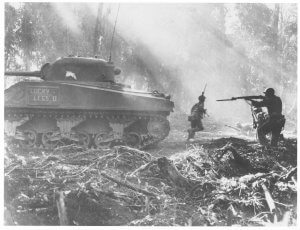
I obtained the following 8×10″ photograph so long ago, I’ve forgotten which museum or library I got it from. It shows US Army soldiers of the 37th Infantry Division on Bougainville in the Pacific in 1944 (probably in April). Clearly the longer (16″ bladed) M1905 bayonets were still carried by some soldiers, even late in the war.
The nature of the Pacific war was such that US GIs might “own” huge swaths of an island for weeks, but still be suddenly surprised at close range when a starving Japanese soldier suddenly jumped out of a spider hole wanting nothing more out of this life than to stick an allied soldier with the bayonet on his own Arisaka before he was cut down. That might explain why these soldiers (including some off to the right in the original version of this photo) are moving around with cumbersome but fixed bayonets.
So common was sudden close contact in the Pacific that Chesty Puller, when he saw a flamethrower prototype, famously asked where one was supposed to affix the bayonet to it.
*****
The M3’s influence on subsequent US bayonet design
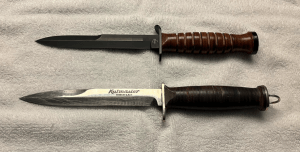
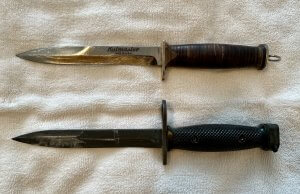
Replica M3 fighting knife (top), next to a Kutmaster M3 variant (bottom). They’re both identical in size; the top one just looks smaller because it’s farther from the camera. Utica Cutlery on NY made military blades during WWII; after the war they marketed the Kutmaster using spare M3 / M4 parts. It had a smaller guard, minus the M3’s thumb bracing (see below), and a lanyard ring in an extension of the tang which protrudes through the pommel. I inherited this Kutmaster from my father’s father. The M3 above is a modern replica made by Boker. H. Boker & Co of New Jersey made M3 fighting knives in 1943. This replica, ironically, was made in Boker’s Solingen, Germany plant.
Most US bayonets during the half century in and after WWII had blades modeled after the M3 fighting knife’s. There were very specific reasons for the shape of the M3 blade, as well as for the reason it was copied on the bayonets that superseded it. Mainly, it was logistics.
One military truism I’ve learned along the way is that
Amateurs study tactics. Professionals study logistics.
There’s no doubt that logistics are the main thing that wins wars, and logistics had a great deal to do with the size of the M3 blade. In 1942, when all materiel was in short supply, the powers that be chose a blade for the next military fighting knife 6.7 inches long, and less than an inch wide. This was to conserve precious steel.
A fighting knife (as opposed to a bayonet) was not intended to convert a rifle into a spear, so length was not hugely important. Rather, it was to gut an enemy who jumped into your foxhole (or after you jumped into his foxhole). In those tight confines, a longer blade might be less usable. It was a poker, meant to be used in short, underhand (low line) thrusts, similar in principle to the Roman gladius hispanensis or the Zulu iklwa.
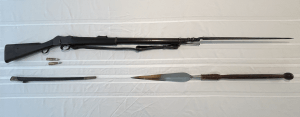
Replica iKlwa (lower right), compared to the Martini Henry rifle used by the Zulus’ enemies. The haft (wooden handle) of the iKlwa was too short to balance out the broad head for throwing; it was strictly a stabber.
The length and width of the M3 compared favorably with the Fairbairn – Sykes commando dagger, the gold standard of Allied fighting knives at the time. The rapier-like, double edged blade of the Fairbairn might slip into a Nazi sentry’s trachea easier, as the blunter M3’s false (top) edge only extended about a third of the way back from the point. This gave the M3 a thicker spine for 2/3 of the blade’s length, which made it sturdier for its most common tasks: busting packing bands off of ammo crates and punching into C-ration cans when one couldn’t find his P38 can opener.
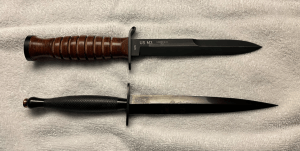
This Fairbairn – Sykes commando dagger (below) is a commemorative replica. It was a gift from the late, great Bill Nuñez, my fellow flier from the 187 Aeromedical Evacuation Squadron. The F-S dagger had a narrow tang and was relatively fragile, compared to the M3. The F-S was a scalpel, a precision instrument for special ungentlemanly tasks.
While it was sturdy enough to cut twigs for camouflage (again, not requiring a long or wide blade), the M3 was never intended as a hacker or slasher. To chop a trail through a Pacific jungle, the Army issued a folding machete.
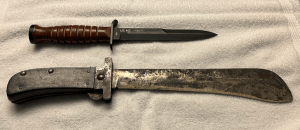
Liner-locked, folding WWII machete with an M3 for size comparison. The blade is marked CASE XX. It was made by WR Case & Sons Cutlery Co. This machete was carried by Joe Eastman’s father, who was a sniper in the Pacific. When folded, it was only about 11 inches long; again, in the highly mobile armies of WWII, excessive size was a detriment.
As with the conversion from the 16″ bladed M1905 to the 10″ M1 bayonet, the 6.7″ bladed M3 bayonet was more convenient in and around conveyances. British commando “Mad Jack” Churchill hight have sported a full sized Scottish claymore sword while storming the Italian village of Pigoletti (it had great intimidation factor when capturing or interrogating sentries), but after the cavalry horses had been put out to pasture, even the officers of WWII found longer blades inconvenient.
One unique and under-appreciated feature of the M3’s guard was that it was tilted forward for thumb bracing while using a “saber” grip. Placing one’s thumb against it provided additional lateral force downward toward the blade, which was helpful as the narrow straight blade was not the best at cutting. It may or may not have been useful when thrusting, which was the M3 fighting knife’s strong suit (see Dawson GP 4 in Appendix II below).
Thumb-braced “saber” type grip on the M3’s forward swept top guard.
The saber grip is preferred in some fighting styles. Many, perhaps most, prefer an ice-pick grip, but even among styles with the blade on the thumb side of the hand, a prison shank or hammer grip is often preferred. One drawback of the saber grip is that it leaves an open door–the gap between the fingertips and the thumb–for the knife to be pried out of the hand, either on purpose by an enemy, or simply during vigorous use.
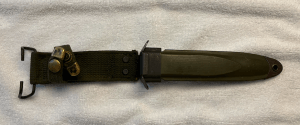
M6 leather sheaths made for M3 fighting knives did not hold up well in the South Pacific’s steamy jungles. Beckwith Manufacturing figured out a way to impregnate cotton cloth (ducking) with plastic, and made the M8 sheath from that material, called Tenite.
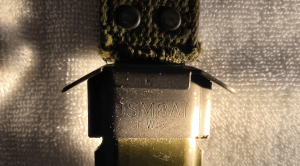
Note the fabric looking pattern of the hard body of the sheath. The metal end cap (and the stamp) tells us this is an M8A1, rather than an M8.
The M8 sheath fit the M3 fighting knife; the “ears” or “wings” on the mouth of the M8 sheath angled down to accommodate the forward angled thumb bracing on the M3, regardless of which direction the blade faced when it was inserted.
T W B initials on this US M8A1 sheath tell us it was made by The Working Blind, previously the Pennsylvania Working Home for the Blind (P W H), between 1965 and 1969.
The downward angled ears remained standard on the M8 (and later the M8A1) sheaths made through the Viet Nam era, and beyond. The M8A1 sheath I was issued when I deployed to Op Desert Shield in 1990 had downward angled ears, just in case anybody had an old M3 to thrust into it. This logistical bonus is called “cross compatibility with other existing systems.”
For more information, do an internet search for Ryan Roth’s The US M8 / M8A1 Scabbard.
The M8 was eventually superseded by the M10 Bayonet-knife Scabbard. My Tech Manual for the M6, M7, and M9 bayonets (TM 9-1005-237-23&P), dated 1993, lists the M10 scabbard but not the M8A1.
*****
M4 Bayonet (NOT the bayonet for the M4 carbine)
The M3 was only made from 1943 to 1944. After that it was replaced with the M4 bayonet, although M3s and their variants saw service in subsequent wars.
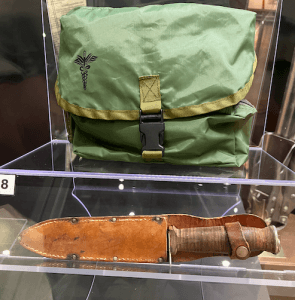
Kutmaster along with a medic bag used by Air Rescue crews in Southeast Asia, in the ‘Nam era section of the National Museum of the Air Force at Wright-Patterson AFB in Ohio. The Rescue exhibit lists artifact 8 as an “M-3 Fighting Knife.” The sheath of my Kutmaster is virtually identical.
The M4 was the same knife, same blade, that fit into the same M8 scabbard, except that the guard and pommel were modified for mounting it to an M1 carbine. An M4 could be used as a fighting knife, but an M3 could not be used as a bayonet, so they decided to standardize. Again, logistics win wars, so armies strive for cross-compatibility of gear whenever possible.
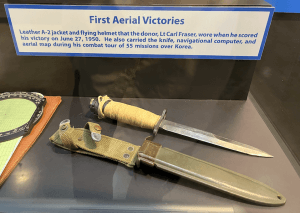
M4 probably intended as a fighting / survival knife rather than as a bayonet, since it’s unlikely that the owner, Lt Carl Fraser, had room for an M1 carbine in his part of their F-82G “Twin Mustang.” Instead of a two-person cockpit, the twin Mustang had two individual cockpits in side-by-side fuselages. The yellow string wrapped around the leather handle was probably for use in survival situations, as fishing line or for lashing the knife to a stick. The sheath is an M8, lacking the metal end cap of the M8A1. Fraser and his other-seater, Lt William G. Hudson, were the first to down a communist aircraft in the Korean War. Artifacts on display in the Korean War exhibit at the National Museum of the Air Force.
The blades on the next 4 US bayonets were virtually identical in shape, length, and width to the M3’s (and each other’s), so they would fit into our existing stockpile of M8 (and later M8A1) sheaths. The only difference was in the grips and requisite mounting hardware:
M4 bayonet (for the M1 carbine)
M5 / M5A1 bayonets (post Korean War era Garand)
M6 bayonet (for the M14)
M7 bayonet (for the M16)
M3 type fighting knife, made by Kutmaster (top) with an M7 bayonet for M16 rifle, made by Imperial (bottom). This photo illustrates how the blades were, for practical purposes, identical in size and shape for 40+ years after WWII.
*****
M5A1 Bayonet
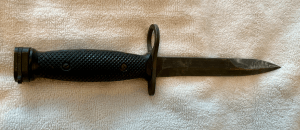
The M1905 and M1 bayonets for the M1 Garand had a tiny button that needed to be depressed in order to release it from the sheath or from the rifle.
Teeny tiny button on left, behind the guard (below the guard in this photo), releases this M1 bayonet from a M1 Garand or a M1903 Springfield, as well as from the scabbard. This meant it would not come loose and get lost, even if the scabbard were upside down, but it also required practice (and no small level of dexterity) to draw the blade from its sheath in extremis. This American Fork & Hoe M1 is from the collection of the late, great Eric Yates, SOCOM intel officer.
At the Frozen Chosin and elsewhere in Korea, the soldiers and Marines often wore thick gloves or mittens, and had difficulty with that tiny button.
The M5 Garand bayonet was adopted in 1953. It had a much larger button or tab just aft of the guard. It also mounted to the rifle with a nub on the guard instead of a larger, more cumbersome muzzle ring (see below). The Korean War ended with a ceasefire (and an uneasy peace to this day) in the summer of ’53, so the M5 may never have seen active service in the Korean war, but the M5 (and it’s slightly modified upgrade, the M5A1) remained the standard issue Garand bayonets for as long as the US issued the M1 Garand to its own troops or its allies.
Despite already being longer than the release button of the M1905 / M1 bayonets, the release catch lever was redesigned again in the M5A1, to make it even easier to use while wearing gloves.
The large button or tab of this M5A1 is in the underside of the grip near the guard, meant to be depressed with an index finger. It’s the forward / visible end of the internal lock-release lever.
To learn more, refer to M1 Garand Bayonets by Mike Popernack.
I can honestly say that my first issued rifle was an M1 Garand, as a “Doolie” cadet at the Air Force Academy, in 1981. One right of passage in “Beast” (BCT, Basic Cadet Training) was the Bayonet Assault Course.
Even Army infantry troops are very, VERY rarely expected to use bayonets in combat. The Air Force had some ground pounding units, like the Security Police (now Security Forces), which are essentially light infantry. Apart from Air Force SF, combat controllers (battlefield air traffic controllers), FACs (forward air controllers, like forward artillery observers for airstrikes), PJs (pararescue jumpers), and BALOs (battalion air liaison officers), the vast majority of Airdales have zero chance of using a bayonet in combat. A pilot isn’t going to use a knife, even off a rifle, unless his parachute is hung up in a tree, or she needs to cut her way out of some aluminum aircraft wreckage. In the 1980s, most of us cadets at the USAF Academy were expected to go to pilot training upon graduation.
Why then, teach us Zoomies to stab tires or stuffed dummies with a bayonet?
The purpose of the Bayonet Assault Course had ZERO to do with slicing, dicing, or making people into Julienne fries. It had everything to do with inculcating an ethos, trying to create what Patton called “The Warrior Soul.”
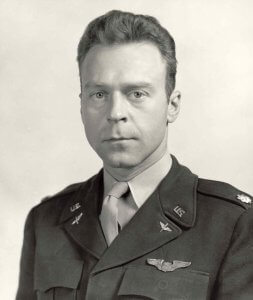
Something approaching the will to combat that made Louis Sebille, fighting desperately to save our outnumbered, outgunned troops inside South Korea’s shrinking Pusan Perimeter, bank his aircraft back around after getting hit attacking a target.
Maj Louis Sebille, Medal of Honor recipient, KIA 05 Aug 1950. Image courtesy of CMOHS.org.
He told his wingmen, “I’ll never make it back. I’m going to get that bastard.” Sebille kamikazed his Mustang directly onto an enemy position, hammering them with .50 cal all the way in.
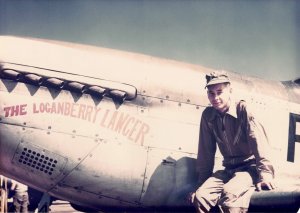
My dad on the wing of his ’51D Mustang, the Loganberry Lancer, in Korea.
A picture of Maj Sebille, along with a summary of his sacrifice, hung in Arnold Hall at the Air Force Academy. His eyes stared at you with that direct gaze, as if to say “This is the standard. I dare you to do better.”
The Bayonet Assault Course was one of many ways they put us on notice that we had not chosen to matriculate at UCLA.
“The spirit of the bayonet is to kill!”
At the Bayonet Assault Course, we learned and practiced the following series of hand-to-hand rifle / bayonet moves:
Slash (diagonal, downward slicing cut)
Smash (longitudinal strike with the butt, muzzle over the support side shoulder)
Thrust (longitudinal stab with the bayonet / muzzle; there may have been some twisting involved)
Butt stroke to the head (horizontal)
Butt stroke to the kidney (upward diagonal)
Butt stroke to the groin (vertical)
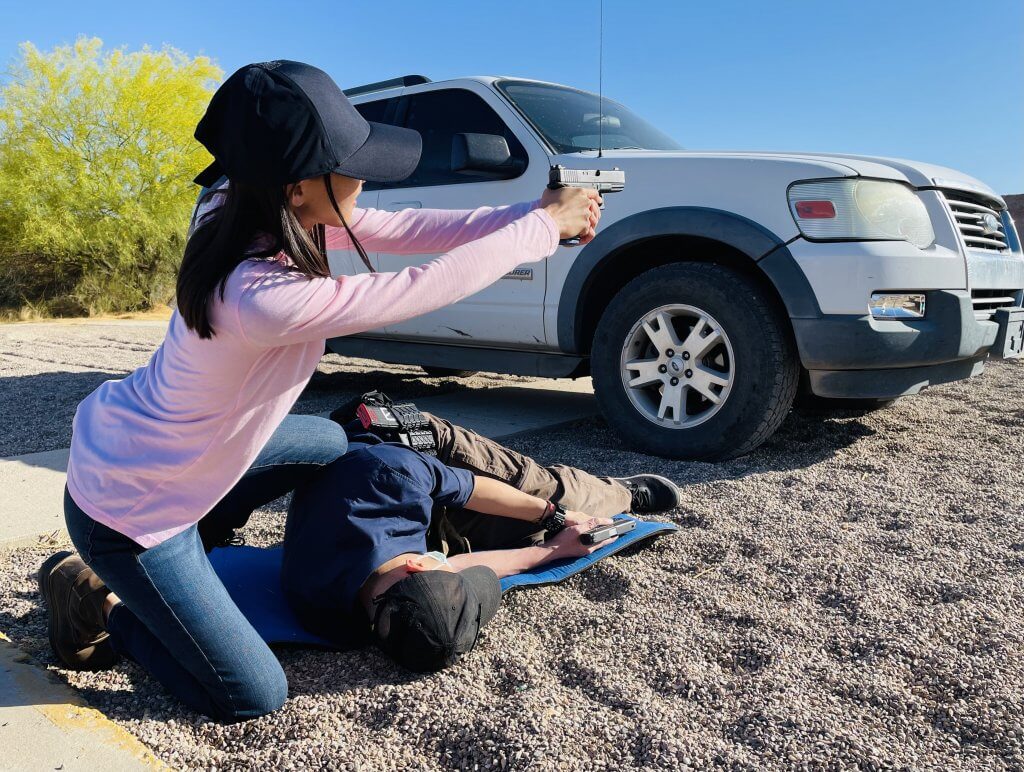
With all the butt strokes, as with the butt smash, the muzzle of the rifle wound up over the support side shoulder. Later, when I was a special agent serving warrants with an M4 (sans bayonet), Eyal Yanilov taught us muzzle jabs, parries, and blocking with the rifle like a side-handle baton, but always keeping the muzzle down range. We avoided techniques that pointed our muzzle back at the rest of the team.
My Garand had a different gas system plug, without a recess wide enough to accept the stud on the M5 series bayonets they issued us at the Assault Course. I had to suffer the indignity of running the Bayonet Assault Course, going through the motions each time, without a bayonet on my own rifle. Most of the other Basics had one, though.
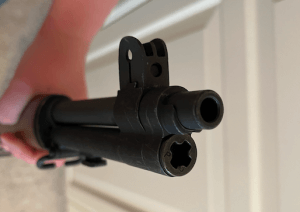
Business end of a Garand rifle. This gas screw (sometimes called the gas plug, below the barrel) has cruciform slots with a large, circular aperture in the center to accept an M5 / M5A1 bayonet.
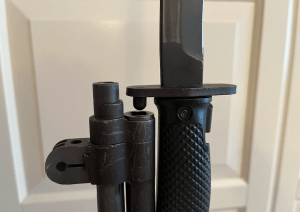
Unlike many other bayonets with their muzzle rings that fit around the end of the barrel, the M5 series had a nub on the guard that mounted into the hole in the front of the Garand gas plug.
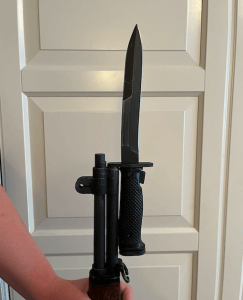
What it looks like with the nub fully seated into the gas plug. This M5A1, with its slightly wonky looking blade, is either a replica or a Korean War contract made by AKI (which I believe are the initials of a Japanese company).
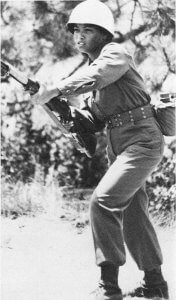
As one ran through the Bayonet Assault Course, one would come up on manikins, tires, or posts representing enemy soldiers and their rifles. Each had a specific required series. A sign would say “Butt smash to head,” or “Parry, Stroke, & Slash,” or whatever.
Note padded, spring-loaded post, representing an enemy rifle this classmate had to parry aside before stabbing or slashing the obstacle off camera to the left.
Our Garands had been demilitarized with lead plugs in the barrels to prevent mischief. The rumor was that before they were plugged, a cadet had committed hara-kiri by placing a blank in the chamber, a pencil in the barrel, and firing the blank to drive the pencil through his head (not entirely unlike what happened later to actor Brandon Lee). Whether the pencil story was true or not, the lead barrel plugs made the Garand even heavier than it had started.
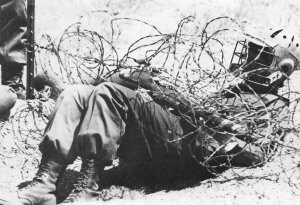
Plus, the air was rare at 7000′ feet or so, in Jack’s Valley. We had to low crawl on our faces and on our backs under concertina wire obstacles.
On one of my runs through the Bayonet Assault Course, I was out of breath and didn’t growl appropriately as I poked at a dummy with my bayonet-less muzzle.
“Come back here, mister!” the cadre supervising that obstacle shouted. “Sound off aggressively when you accomplish my obstacle!”
I redoubled my efforts, screaming “Die, you communist son of a bitch!” and hit it with all my might.
“Don’t swear on my Assault Course,” the cadre said, laughing and sending me on my way.
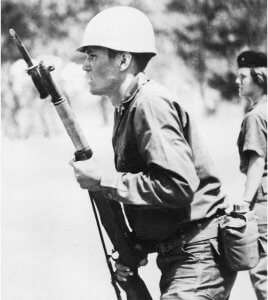
These black and white photos, taken by Steve R, class of ’83, are from my BEAST ’81 yearbook, printed by Walsworth
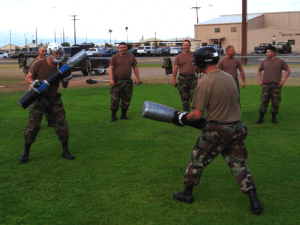
We also sparred against our classmates with genuine pugil sticks (the Marines train with pugil sticks first, to get the footwork and stability down, before moving on to bayonets).
Soldiers of HHB, 1/180 Field Artillery spar with pugil sticks during our 2003 – 04 callup for Op Armored Falcon.
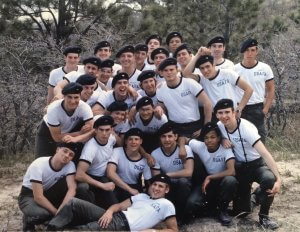
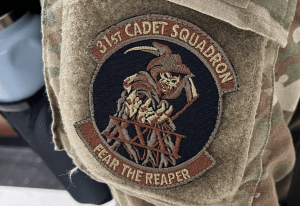
I wasn’t very good at pugil sticks during Basic at the AF Academy, but my thrusts (similar to muzzle strikes, had we been wielding rifles instead of giant Q-tips) under my opponent Rusty B’s chin worked pretty well. Mostly, though, I was the one getting pummeled. Rusty was one of my mates, first in BCT Squadron A (“Aggressors”), and later in Cadet Squadron 31, the “Grim Reapers.”
My Grim Reaper classmates, so named on the theory that if we ever had to come after you, it wouldn’t be the salmon mousse that did you in. Rusty, who devastated me (and, to be fair, just about every other opponent he sparred against) with pugil sticks, kneels third from (your) right. Photo probably taken by Dawn Q, courtesy of Eagle Driver “Slammin’ Sam” D.
“Grim Reapers” is probably too hostile and aggressive a squadron name for this modern era, and will no doubt soon be replaced with “Friendly Nation Builders” or some such.
. . . but I must admit the CS-31 patch cadets wear these days is cooler than the one we had on our athletic jackets in the early 1980s.
RECONDO
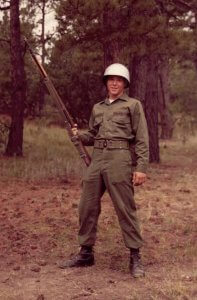
Two years later, in July of ’83, I attended a special session of the 4th Infantry Division’s Primary Noncommissioned Officer course at Camp Red Devil, Colorado. I say “special” because it was an exchange program, of sorts. Air Force Academy cadets spent three weeks at Ft Carson, learning a little about Army life (and how good they had it in the Air Force).
The program was called RECONDO (an abbreviation of Reconnaissance and Commando). We were taught LRRP (Long Range Reconnaissance Patrol), as well as ambush patrol, and other patrolling techniques, as a vehicle for practicing leadership.
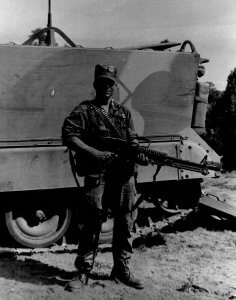
There were three squads of students, and we each took turns briefing, and then leading our squad through patrols and various MILES (Multiple Integrated Laser Engagement System) combat exercises. We trained with grenades and LAW rockets and saw demonstrations of RPGs being fired. There were also some mech infantry (ambush response in M113s) and live fire US and ComBloc small arms familiarization thrown in there.
With a hog (M60) in front of an M113 APC. Note MILES receptors on web gear. Photo by Chris Cassidy
Most of the PNCOC instructors had unit patches from Vietnam on their right sleeves. Their main mission in life seemed to be convincing us to NOT become the kind of young lieutenant who heroically leads his troops to slaughter doing things like bayonet charges, if there is a smarter, more effective or less costly way of doing business.
The RECONDO cadre were men of few words, but I could tell they were very proud of being grunts, something most others were (and still are) neither able nor willing to do.
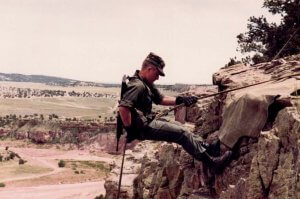
Rappelling at RECONDO, with “Rosa Linda,” my PNCOC issued M16A1.
Attending the Army RECONDO course qualified us to be BCT cadre on the USAFA Tactical Leadership Decisions course. At TLD, I worked with a Captain Kinney, who had served on a UN peacekeeping force (I believe in the Middle East). Capt Kinney carried a very light field knife made by a then-unheard-of (on this side of the Atlantic) company called Glock (see below).
*****
M7 Bayonet
Volant Scorpion
When my SP outfit went through the Volant Scorpion Airbase Ground Defense Evaluation at Little Rock AFB, Arkansas in the summer of 1988, we ran through a bayonet assault course with M7 bayonets on our M16s. One of my fellow blue beanies (security policemen), named Zaug, snapped the stock of his M16 in half doing a butt stroke.
I don’t remember any of the far-older Garands we bashed into things in Jack’s Valley breaking like that. I guess it’s true: “They don’t make ’em like they used to.”
Ops Desert Shield and Desert Storm
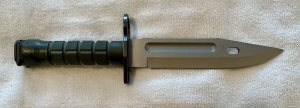
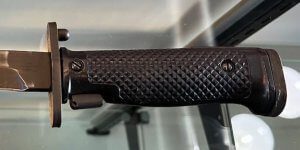
We were issued M7 bayonets when I deployed to Operation Desert Shield in August of 1990. The M7 had a dark grey parkerized blade. The tang was covered with a clam shell pair of plastic, checkered grips. Ours were made by Imperial.
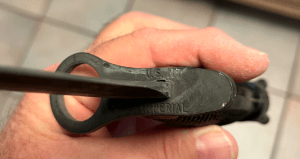
American bayonets are traditionally stamped on the blade side of the crossguard. This one says U.S. M7 on the left, and IMPERIAL on the right side of the blade.
Apart from opening MREs and other common cutting tasks, I only used a bayonet twice during that deployment, that I remember.
Before the war started, we were working on the King’s side (the “Royal Ramp”) of King Khalid International Airport when I locked myself out of a red and white checkered guard shack, at a flightline entry control point. I used the M7 to pry the pins out of the door hinges, and then to pry open the door.
Plus, I can honestly say I’ve taken a life with a bayonet, during wartime.
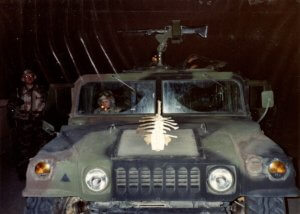
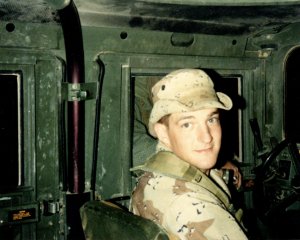
Our Humvee. I’m sitting where I usually sat, in the front right seat, where I was when I gave Lobraico his slithering surprise (see below). Some of our Hummers were painted tan; we got those from pre-positioned stockpiles Uncle Sugar kept on hand in Saudi for contingencies (those started with low triple digits, sometimes even double digits, on the odometer). Others, like this one, were borrowed NATO war reserve materiel. We found the camel skeleton in the desert and strapped it to the hood with 550 cord for that Mad Max look. Our squad leader Craig S stands outside the HMMWV’s right rear door. T-Bone’s hog (M-60 GPMG) sits on the pintle mount.
We were patrolling sector Echo 14 at night (we worked sundown to sun up) on the commercial side of the airport, when we came across “Worm,” a Saudi Amn troop who had parked his Suzuki Samurai type patrol vehicle by the side of the road.
He had run over a snake.
The poor thing was biting its own tail. Not sure why, whether trying to peel its body off of the road, or to put itself out of its misery, or some other fatally wounded, primordial urge. Worm wouldn’t get near it, and signaled that we shouldn’t either.
I didn’t want to get close to it, and I’m not into killing snakes, but I didn’t want it to suffer. Lacking that best wounded snake euthanizing tool, a long handled shovel, I put my bayonet on my M-16 and, standing as far away as possible, cut off its head. I stuck the head with the bayonet and ditched it far from the road.
Then we drove over to our sector’s border with the adjacent patrol sector. When the other fire team pulled up in their Hummer and parked to chat, I tossed the still slithering snake’s body though their window, into T. Lobraico’s lap.
T. Lobraico (standing outside the window). He was sitting in an adjacent Humvee when I pranked him.
Lobraico about climbed over the back of his seat.
Such hijinks kept us awake on those 12 hour midnight shifts. I hadn’t planned on bushwhacking any particular person; Lobraico’s window was just the first to roll up within range of my snake tossing abilities.
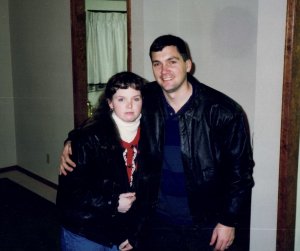
Lobraico and his lady at my place after the war
Like many of us, Lobraico later went into went into civilian law enforcement. He also wore the blue beret of the Security Police (subsequently renamed Security Forces) for many more years in the Air National Guard.
Lobraico’s son, TJ Jr, followed his father’s footsteps into the Security Forces. TJ Jr served in Iraq, and sadly, was subsequently killed in a gun battle outside the wire of Bagram Air Base, Afghanistan.
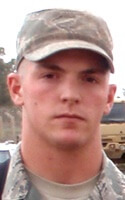
SSgt TJ Lobraico Jr, KIA 05 Sep 2013. Photo courtesy of Military Times
*****
Glock Survival Knife
Although I kept that M7 with my ALICE ruck sack, I carried a Glock Survival Knife 81 (inspired by Capt Kinney’s example) on the left suspender of my LBE, load bearing equipment. I wore a Mini-Maglite AA flashlight, with a red lens for reading maps, etc., fastened with tan duct-tape to the Glock scabbard.
French FAMAS F1 with its over-the-barrel bayonet. Hilt of the Glock knife is clearly visible on my left LBE suspender.
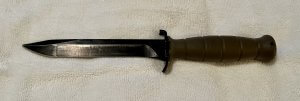
The blade of my Glock Survival Knife was thin (quite similar to the clip-point M3), and it never seemed to take an edge. It had (almost overly) aggressive, sharply angled serrations on the spine.
A Glock Field Knife 78, without the 81’s serrations on the spine.
The main reason I carried it was because it was very light weight (7.1 oz), and weather resistant (like their pistols, which took the law enforcement world by storm within a few years). Un-snapping it from its sheath was just a tad awkward, but it snapped in easily, and it stayed in its sheath when I carried it grip-down.
Some sources I’ve read say that the Glock Field Knife had originally been intended as a bayonet (see below) I’m still not sure I entirely believe that.
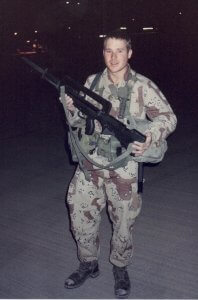
The Glock knife had a bottle opener built into the cross guard. When I first read on the internet that it was not intended as a bottle opener, and had been designed to hook onto the flash suppressor of the AUG, I was skeptical. I’d been issued a US Customs AUG-P and the shape of the suppressor just didn’t seem to fit with the shape of the bottle opener on the Glock knives.
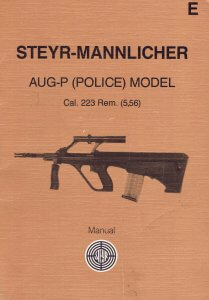
There was no mention of a bayonet in the Steyr AUG-P manual (I’ve not read a manual for the military version).
Then I saw an alleged copy of some early AUG advertising which showed the 78 stuck onto an optional mount with the top of the bottle opener braced against the lip of the flash suppressor (not hooked on it; see worldbayonets.com). One would have to install the optional mount on the AUG, and then remove the pommel of the knife to reveal the socket (the hollow grip) that would fit onto the mount.
The forward bend of the bottle opener made the hilt of the Glock knife less prone to jamming one’s thumb when using a “Saber” hold (similar to a “Hammer” or “Prison Shank” grip, but with the thumb braced along the spine; see M3 above and Dawson GP4 below). Holding a knife in Saber fashion didn’t concern me all that much till after I took a Gunsite / PDSI Edged Weapons course 7 years later, in March of 1998.
*****
Phrobis III M9 bayonet
Sometime during Op Desert Storm, we were issued the Phrobis III M9 bayonet. Its blade was both wider and thicker than the M7’s. Eventually, I put that M9 on my LBE (replacing the much lighter Glock knife), ostensibly to test it under combat conditions.
Apart from dodging the occasional SCUD, the main thing we combatted was the mythical, sleep inducing “Z-monster,” trying to stay awake and alert as sentries should. Mainly, that M9 killed defenseless MRE packages.
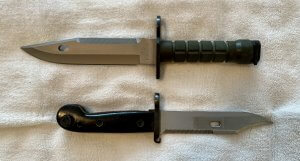
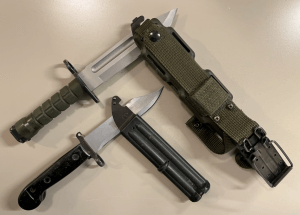
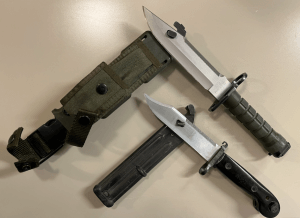
The M9 (above in this photo) borrowed much from the AK bayonet (below), including the hole for the scabbard-mounted T-lug (like the pivot point of scissors) converting it into wire cutters.
The wire cutting feature gave you much more leverage than you could get with a Leatherman type multi-tool.
M9 with wire cutter scabbard (top), AK bayonet with wire-cutter scabbard (bottom)
Multi-tools were not nearly so ubiquitous in those days as they are now.
Before I was issued that M9 bayonet, I made it a habit to always carry a small pair of needle nosed vice grips in my load bearing equipment (LBE), and not just for the wire cutter. Vice grips can give you a handle, and leverage, on a great many things that non-locking pliers cannot. The stick shift of my Jeep POV was held in place by a set of vice grips for years (an amateur mechanic had busted the flanges that were supposed to keep it mounted to the Borg-Warner T-5 transmission).
Duct Tape & Needle-Nosed Vice Grips
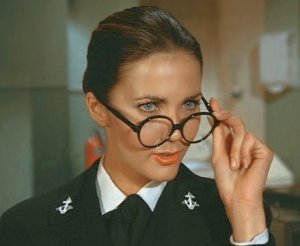
I often joked, when I was young and single, that if I had to be stuck on a deserted island for a year, and I could take either needle nosed vice grips and duct tape, or Lynda Carter, there would probably be occasions during the ensuing year when I’d wish I had some needle nosed vice grips.
Lynda Carter’s “Wonder Woman” persona was OK, but her “Yeoman Prince” was WAY more desirable than needle nosed vice grips, even with the duct tape thrown in. Maybe I’m just a sucker for a woman in uniform. DC / Warner image, via Pinterest
I understand US Army Rangers used the M9’s wire cutter feature on chain-link fence to take an objective during Operation Just Cause.
M9 with wire cutter scabbard (top) and AK bayonet with wire cutter scabbard (bottom)
Both the AK and the M9 bayonets had angled serrations on the spine, useful when sawing off branches for camouflage. Not too much vegetation where we were at, north of Riyadh.
Note that the cutting edge of the AK bayonet is inverted (on the top); when mounted to a rifle it cuts by pulling up, rather than pushing down. I’m guessing that in ComBlock bayonet doctrine, their equivalent of a slash series was more of a “stick and lift.”
I took a course called AK 47 / 74 in CQB from Saulius “Sonny” Puzikas, a former Spetsnaz operator. We worked extensively on off-lines, disarms, retention, muzzle jabs, and other ways to beat someone with a Kalashnikov, but I don’t remember much attention being paid to bayonets.
The Soviets couldn’t (or wouldn’t) make a toilet seat that didn’t break; their consumer goods were of notoriously poor quality. Their weapons, on the other hand, were sturdy and practical. The chisel tip of the Mosin-Nagant spike bayonets, for example, doubled as a screw driver.
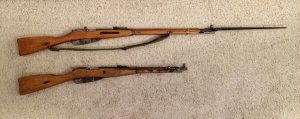
Mosin Nagant M1891/30 (top) and Chinese Type 53 copy of Mosin Nagant M1944, with bayonet folded. Both bayonets had a chisel tip that could be used to remove the screws that held a Mosin action in the stock.
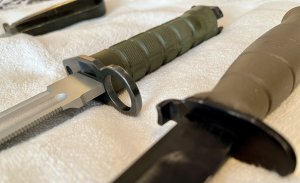
The M9 bayonet had a wider, Bowie style blade. In yet another example of life imitating art, the M9’s cylindrical grip was clearly modeled after Sylvester Stallone’s Lile survival knife from Rambo (a custom design that was, in turn, based in concept on the Vietnam era Randall 18 survival knives). Rambo’s custom made Lile and the Randal 18s had storage compartments in the hollow cylindrical grip; the M9 did not.
Despite the hollow-looking handle, the (earlier production) M9 was perfectly balanced, if heavy; the center of gravity was just aft of the guard, where it should be.
I later took a Bowie knife course, and found that the fat-bellied Bowies were meant to fight as choppers, as well as stabbers and slashers–similar to a khukuri,* bolo, or smatchet. Some other EW disciplines make the strongest part of the grip the last three (middle, ring, and pinkie) fingers. When using a chopper to chop, the wielder does just the opposite, holding the last three fingers relatively loosely, and allowing the weight of the blade and guard (if any) to pivot the knife around the index finger. The thumb locks in tight to keep you from losing the chopper.
The fat, circular cross-section of the M9 does not lend itself as well to this technique (at least with my stubby fingers) as the thinner, oval cross-sectioned rubber grip of the Marine Corps’ OKC 3S (see below).
The original Phrobis III and Buck-made M9s had a single, deep, very cool looking fuller, commonly called a “blood groove” (a misnomer).
Swords were fullered, not to assist with blood letting, but rather to reduce weight (and the amount of metal used to make the sword) while retaining strength and rigidity, like the H-shaped cross section of an I-beam used in building construction. Later, cheaper production models of the M9 lacked the fuller.
The Phrobis M9’s deep fuller was on the right side only. Even with the fuller, it weighed about a pound and a half; that’s just a bit more than a Glock 19 weighs empty.
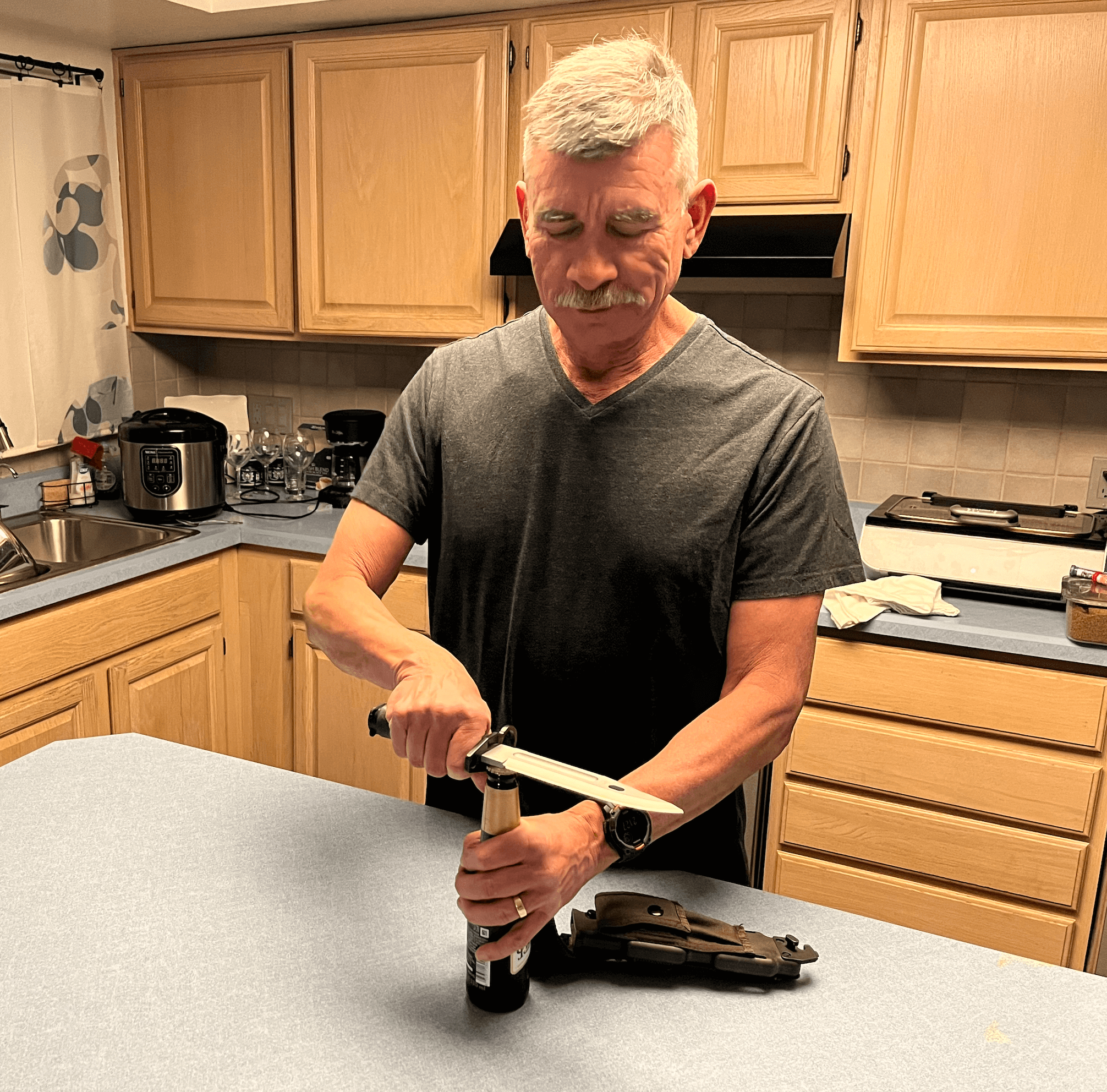
As Marty McFly showed us, US domestic soda pop production had converted to twist-tops by the mid 1980s (when the M9 was adopted). More expensive imported beers still required a bottle opener.
Phrobis (& Buck) one-upped the Glock knives by incorporating not one, but TWO bottle openers into the guard of the M9.
Bottle openers integral to the cross-guard: bent end of the guard on a Glock knife (right), and below the muzzle ring on either side of the M9 blade (middle).
An old and dear friend demonstrating proper technique with the same type of M9 he had been issued when he manned the bastions of freedom in Honduras.
I suppose dual bottle openers would be useful if you were too drunk to figure out which side of the blade’s ricasso to put on top of the bottle cap; but if you were that impaired, and using a bayonet instead of a “church key,” you’d also be likely to wake up without fingers. I believe that later “lowest bidder” military contract production M9s also lacked the bottle openers.
The Phrobis M9 was the only bayonet I was ever issued with a silver (or grey, bead blasted) blade. I believe it was stainless steel. Given that the purpose of the bayonet is primarily psychological, they all should probably have bright, shiny (at least polished blue) blades. Harder to fear something one cannot see.
The Leyland AmBus
One night we were hanging with some blokes from the RAF Regiment (or maybe British medics; I can’t remember now). Several field hospitals had been set up in and around our base, on the off-chance the blood-bath predicted by Senator Ted Kennedy actually occurred (God be praised, it did not; the ground campaign only lasted about 100 hours, and Coalition forces suffered 147 KIAs; the Desert Storm KIA number was adjusted to 148 during the next Iraq war, when the remains of an MIA pilot were found).
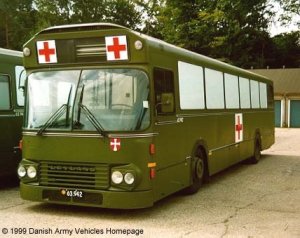
We were chatting beside an AmBus, or Ambulance Bus. It was a long, bus-sized military vehicle set up with litter tiers for transporting many casualties. The AmBus was made by a company called Leyland.
A Leyland Ambulance Bus in Danish Army service. The one we were messing with was British, and painted desert tan. Image from armyvehicles.dk.
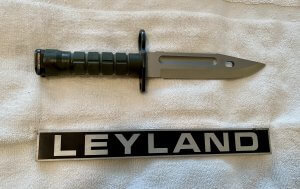
We knew the manufacturer because there was a metal LEYLAND plate (like a Ford or GMC emblem) hanging off the back end of the bus. It was affixed to the body of the AmBus by two bolts. One bolt had broken off when the bus had been backed into something, so the emblem hung down sideways.
We were bored–that perennial bedevilment of night watchmen. Jason B, the driver for our fire team, pulled out his magnificent Buck-made Phrobis III M9 bayonet, and tried to pry the Leyland emblem all the way off.
Jason B, our driver and assistant machine gunner.
The blokes had always been somewhat less blessed in the supply department than the over-fed Yanks. Some of their gear seemed to date back to lend-lease in WWII. The M9 bayonets (at least the well-built, original ones) were famously expensive, and the British soldiers were horrified.
“I say, mate, aren’t you afraid you’ll snap that blade, using it as a pry bar?” one of them asked.
“Well, if it breaks, it ain’t worth a shit, now is it?” Jason replied.
The thick blade of Jason’s M9 did not break, but neither did the manufacturer’s emblem give up the ghost. I eventually just unscrewed the nut holding it on from the other side, and kept it as a memento of that Arabian night.
In March of ’91, when we left Saudi after Desert Storm, I gave the Glock knife to Faris, a Saudi Warrant Officer who served as our unit’s liaison to the Saudi Amn (security) forces.
I kept the M7 and the M9, and have them to this day. As a reward for our wartime service, our leadership ripped up the Forms 1297 (hand receipts) for the M9s before our very eyes, and nobody seemed to care much about the obsolete M7s. I never even cleaned off the paint transferred from the red and white checkered guard shack to the parkerized blade of that Imperial M7. It wears the paint as a badge of honor.
White and red paint from the Amin guard shack on the false edge.
*****
USMC 3S bayonet
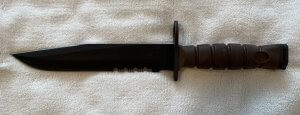
Clint Smith described the latest USMC bayonet, the Ontario Knife Company 3S, as “basically a Ka-Bar.” It represents a welcome improvement in evolution of the bayonet. The big blade is thick and stout.
Ka-Bar-like USMC 3S bayonet made by Ontario Knife Company. Chopper, slasher, poker–like its US Army M9 predecessor, only better.
If the blade were any bigger, it would practically be a Bowie-shaped Roman gladius hispaniensis.
The OKC 3S is balanced right at the guard. It has a thin, rubberized handle. The serrations on the aft third of the blade are very effective, and appear to be Spiderco inspired.
The 3S was developed during the opening years of the GWOT, because the Marines took their edged weapons seriously–all the more so during wartime.
Meme on Pinterest; I believe the image is from Fallujah.
The USMC still teaches the bayonet in boot camp.
And yet . . . there are even Marines who feel the bayonet is obsolete.
In an article called “Is the age of the Bayonet over? An example through the Marines of 1/1” (posted on 08 Sep 2016), a blogger named Miles (miles@tfb.tv) stated that when his unit deployed, they drew their rifles and bayonets at the armory. Each squad leader collected up all the bayonets in a locked duffle bag, and they stayed in the bags till they were turned in, stateside, after the deployment.
Apparently, their leaders felt they couldn’t be trusted with sharp objects, lest somebody lose a toe playing mumblety peg, or loose a bayonet (which would, inevitably, result in everybody in the unit having to search for it till it was found).
There may be just a hint of sour grapes in his conclusion, but Miles had some very valid points. In the age of standing around waiting to be blown up by suicide bombers, maintaining distance from the enemy is the goal, and training time is better spent practicing how to do a 9-line MedEvac report. Or, as Bing West said in No True Glory: A Frontline Account of the Battle for Fallujah,
“You can do almost anything with a bayonet–except sit on it.”
West, a Vietnam Marine and former Assistant Secretary of Defense, used the word “bayonet” to refer, figuratively, to the Marines, an assault force trained and equipped to tear down regimes. “Sitting on it” meant occupational, hearts and minds, nation building duties (West also noted, on page 18, that 68% of our fatalities in Iraq were due to IEDs).
West was paraphrasing Charles Maurice de Talleyrand-Perigord, Napoleon’s foreign minister, who allegedly said that sitting on bayonets was uncomfortable. Incidentally, Napoleon himself was stabbed in the thigh by a British (or French rebel) bayonet at Fort Mulgrave, when he was a younger officer.
One problem with using bayonets AS bayonets, i.e., on the end of a rifle, is that mounting them requires malice of forethought. They mess with a barrel’s harmonics and make the rifle less accurate at distance. They make it longer and therefore more cumbersome in tight quarters. And yet they are only useful at close range (unless they are used in a charge, as a psychological way to seize the initiative and force the enemy to break contact).
Accordingly, if a soldier is clearing a building or narrow alley, s/he will probably NOT have a bayonet on the rifle. When they are bushwhacked in that room or alley, they won’t have time to mount it. If an edged weapon is used at all, it is likely to go from the sheath to being sheathed, hilt-deep, in the enemy combatant, without spending any time on the rifle.
But that won’t happen if their leadership, like 1/1’s, doesn’t even trust them with sharp objects. In that case, rocks, helmets, maybe an entrenching tool will be used.
Or a pistol. See Dual Arming for more on replacing the bayonet with a pistol.
–George H, Lead Instructor, Heloderm LLC
*Khukuri (Nepali: खुकुरी) is also anglicized kukri, although the khukuri spelling is closer to the way the Gurkhas pronounce the name of their trademark weapon.
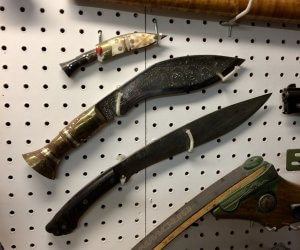
A khukuri my sister brought me from Nepal (center). Not to be confused with the bolo below it. I believe my dad got that ebony handled bolo during aircrew survival training in the PI, for his combat tours in Southeast Asia.
*****
Appendix:
A few more EWs (edged weapons) I carried overseas
Ka-Bar K-2
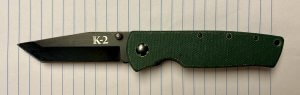
On my last all-expense-paid Middle Eastern vacation, in 2008, I don’t remember even being issued a bayonet. My Security Forces squadron issued us Tanto-tipped K-2 folders instead.
That sturdy little liner-lock had OD green Micarta or G-10 panels. Although it bore the Ka-Bar K-2 logo, it was made in China, and was probably picked up by my squadron on a local purchase. I carried it clipped to my PT shorts the 11 or so hours a day I was off duty.
Dawson GP4
When I was on duty, for most of my 2008 tour, I carried “Lakshmi Bai,” a custom-made Dawson GP4. It was an earlier prototype, when the GP4 still had the sub-hilt.
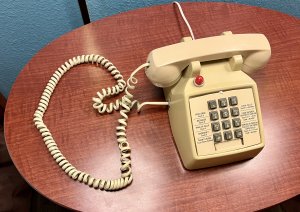
I mounted it horizontally over the chest plate of my Level 4 vest, with the grip on the right side (but accessible to both hands, as a backup weapon should be). It had a telephone chord-type lanyard (look up “telephone chord” in a history book, kids).
In case you’ve never seen one.
I wasn’t really concerned about losing the knife, but I used the lanyard to hold my Kevlar groin protector up when I needed to take a leak. The groin protector, in turn, wasn’t so much for ballistic threats as to keep me from wracking myself in the junk with my M4 as it hung from a single-point attached to my vest.
Note Dawson GP4 behind butt of rifle.
Not a huge fan of single point rifle slings, but I used one exclusively in Kuwait, and often used one with my issued AUG-P and M4 when serving warrants as a special agent. In both uniforms, I was a tac-medic, carrying an EMT jump kit in a ruck sack. The single point kept me from having any tangles when it was time to unlimber the medic pack.
The convenience store at Ali al Salim sold small throw rugs. I lashed a couple rugs around one post of my bunk, creating a field expedient pell. Whenever I got back to my room after a shift, before I doffed my armor, I stood with my back to that bedpost and practiced about 5 left-handed presentations (to an ice-pick grip), stabbing that pell as if into the groin of someone who attacked me from behind, while I pressed an inert replica M9 into my holster as if to retain it (I turned in my real M9 at the armory when I got off duty). I moved up to an upward armpit strike, and then a downward subclavian stab, as I pivoted left and drew the “blue gun” M9 to a retention position with my right hand, while keeping my left hand, still holding the Dawson knife, up to protect my neck.
That sort of daily kata is not only useful to unwind after a long shift (and to annoy Justin, the other TSgt in the room, who worked the opposite shift, on the one day a week he got to sleep in). It’s a way to stay mentally sharp, to keep that last aspect of warrior ethos I mentioned in Dual Arming, the switched-on readiness to engage in close quarters combat on a moment’s notice, front-loaded in your brain.
The 15:17
If you learn you’re going to be in a struggle for your life (and the lives of your coworkers) today, my advice is to call in sick. If you’re already at work when you get the engraved invitation, my advice is to bring a rifle, and many steroid-abusing friends with rifles. But few who find themselves suddenly thrust into an active killer event saw the email ahead of time.
Warrior ethos is important for professional soldiers, but you don’t need to be in the military or law enforcement to gain and maintain it. A waitress can be a warrior protector. Alek Skarlatos, Spencer Stone, and Anthony Saddler–a soldier, an airman, and a civilian, in respective, descending distance-from-the-tip-of-the-military-spear order–were ALL “switched-on” enough to respond effectively (with EMPTY HANDS) to a sudden surprise attack by a terrorist with an AK, a pistol, and a knife on the 15:17 train to Paris.
As part of my after-work ritual at Ali al Salim, I also faced the bedpost and practiced strong sided presentations, working the pell with slashes from 8 different angles. I practiced direct thrusts to about the pell’s solar plexus and trachea levels (with twisting motions at full extension). I finished the strong side foot forward drills with indirect thrusts to the left and right sides of the base of the neck / subclavian region of the pell, as if working around a hostage.
Coming at the upper left side of the pell in such an indirect, backhand manner was always my weakest of those moves, all of which I’d learned from Richard Ryan at Gunsite. Lakshmi Bai’s sub hilt helped, as a “saber” grip is hard to maintain at that angle. But it was a good-feeling back stretch, after spending 14 hours hauling 60+ pounds of armor, ammo, and gear around.
Teaching that same method 14 years later. Shielding elbow should be lower than in this photo.
Then I switched up my foot position, closed with the bedpost as if in tight quarters and unable to back out, and practiced the “Singer Sewing Machine.”
That Dawson GP4 had very aggressive thumb bracing in the hilt. Thumb bracing is a good thing if you stick the knife into something that stops its forward motion, when your hand’s momentum makes it tend to keep going. This is one of several reasons that kitchen knives aren’t the best for fighting.
However, Lakshmi Bai’s hilt kept jamming my thumb. Over the months, the more I practiced with that Dawson, the less enthusiastic my forward thrusts became.
I could have switched to a prison shank or hammer grip for those forward thrusts, at least for the switch-foot Singer sewing machine practice. Instead, I maintained my saber grip but didn’t strike as hard.
You’re either all-in, or you’re not.
Cold Steel SRK
I wound up giving that beautiful, functional Dawson away and replaced it with a far more generic, rubber handled Cold Steel SRK. Plenty sharp enough, it never held quite the edge, or felt as handy, as that that Dawson did, nor was it nearly as elegant. But I wasn’t afraid to stick it into the pell full-speed.
The world’s best tools won’t help anybody who doesn’t train to master them.
 With all the butt strokes, as with the butt smash, the muzzle of the rifle wound up over the support side shoulder. Later, when I was a special agent serving warrants with an M4 (sans bayonet), Eyal Yanilov taught us muzzle jabs, parries, and blocking with the rifle like a side-handle baton, but always keeping the muzzle down range. We avoided techniques that pointed our muzzle back at the rest of the team.