Over in 2 Seconds: 25 Apr 2026
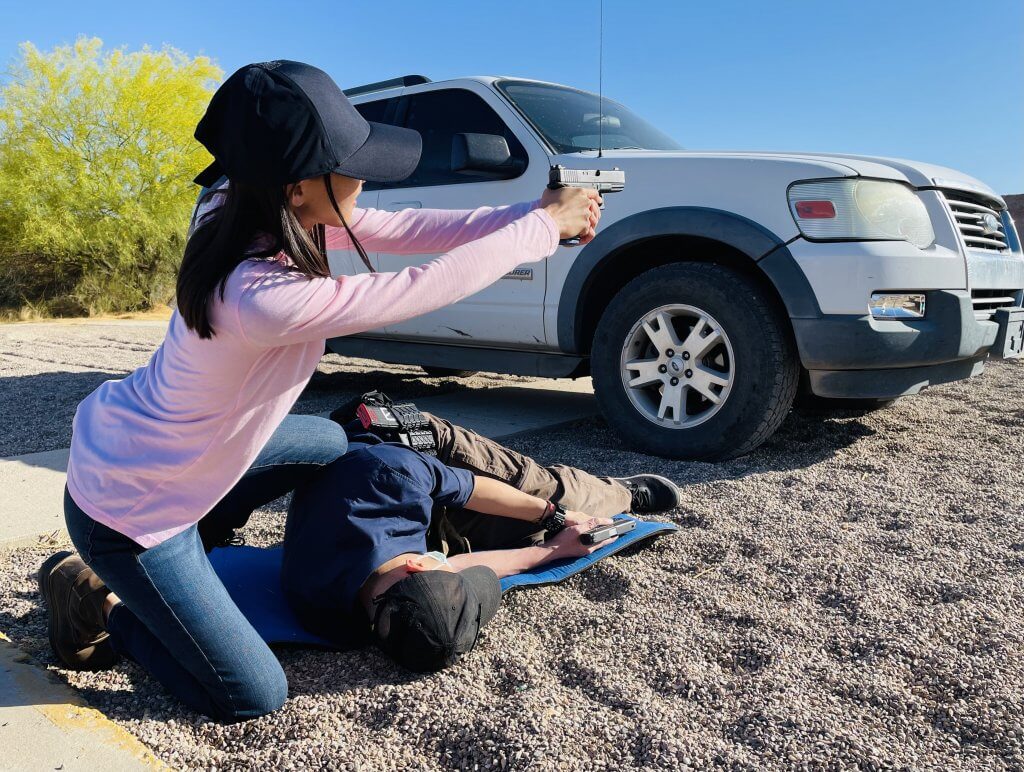
On 05 May 2026, I taught a baton class to house of worship security volunteers. To put things in perspective (“keeping the main thing the main thing,” as my friend and co-instructor Ian T. said), we walked through a recent perimeter security breach with several valuable lessons for security teams.
On 25 Apr 2026, a “lone wolf” attempted to assassinate senior members of the US Executive branch of government. He checked into the Washington Hilton a few days in advance of a planned gala, with a shotgun, a pistol, and knives. As uniformed and plain-clothes US Secret Service / DC Metro Police security teams stood by, he ran through a magnetometer, shooting at the one guard who saw him coming.
He did not attempt to mow them all down, as the security personnel were not his objectives (in advance of the attack, he stated that the guards were not his primary targets, and he would only attack them “if necessary”). They security minions were simply a speed bump he needed to pass to achieve his goals of eliminating the president, et al.
Had it been a coordinated (Mumbai / Paris) type attack, one part of the team would have mown down the guards at the entry control point, breaching a hole so others could penetrate deeper with a fuller complement of ammunition / explosives. Or, the attack at one checkpoint would have been a distraction to draw guards away from other points.
The actual (and, as it turned out, limited) breach happened in about two seconds.
To illustrate the breach and various responses to it, I set up a PVC-pipe frame about the dimensions of a magnetometer. We set up a row of chairs representing the large rectangular shipping box roughly in the center of the images below. Our students were posted around the scene, representing the clusters of Secret Service / DC Metro security personnel at the ECP.
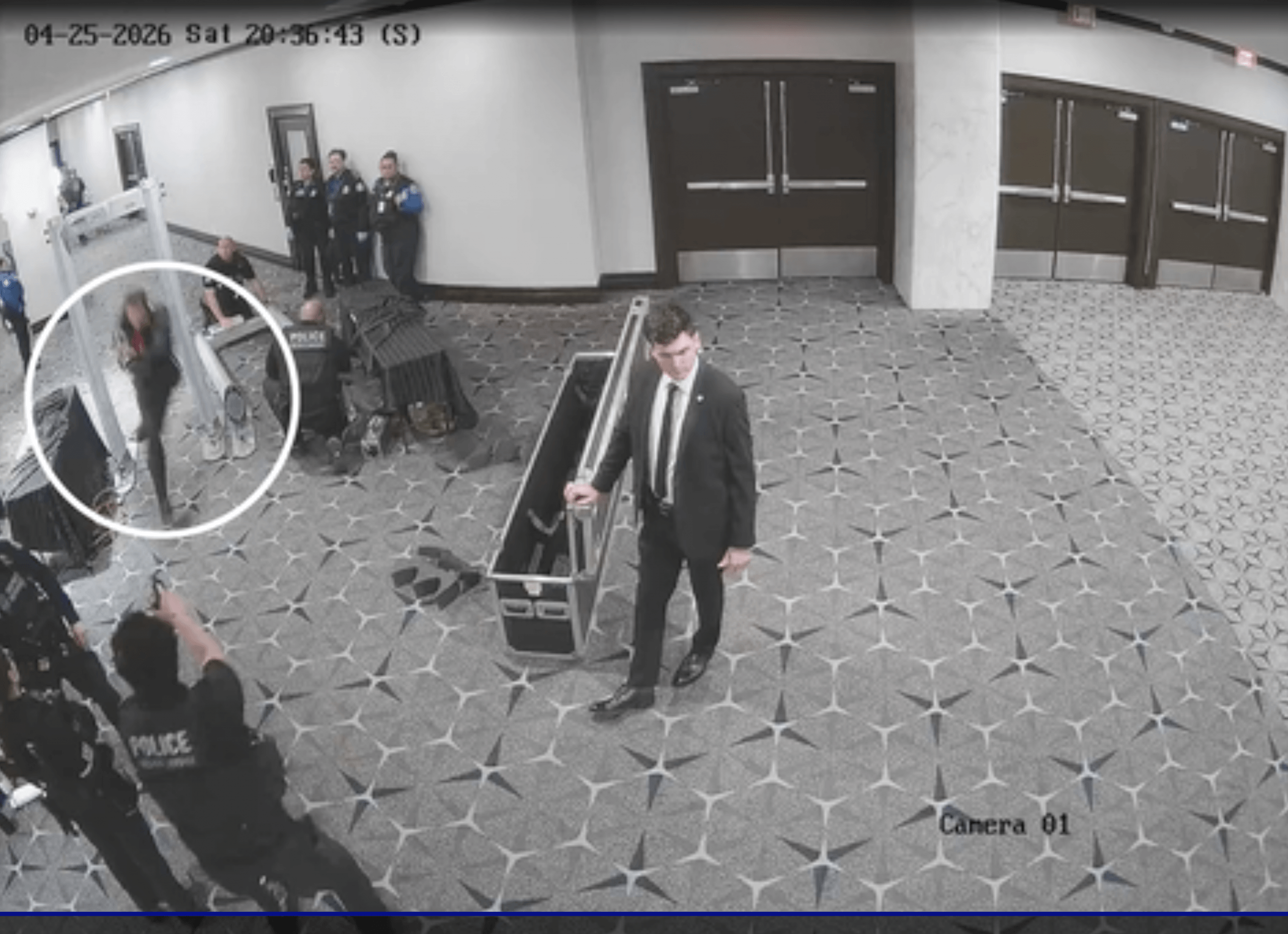
In the image above, the assailant has come out of a door across the hall and is running through the magnetometer, firing the shotgun at the first officer (let’s call that person “Responder 1”) who noticed the assailant. Not surprisingly, Responder 1’s trained response was to draw and shoot back.
*****
Tunnel Vision
My limited experience on the two-way range has been that gunfights bring a clarity of focus and a sense of immediate purpose that is otherwise lacking in my (and I assume most people’s) day-to-day life. As Responder 1 looked at another human being, who was trying to kill them, over the sights of Responder 1’s pistol, and pulled the trigger, hitting that rapidly moving threat probably became the only thing that mattered in Responder 1’s entire world.
My educated guess (and, even with all my training and experience, a guess it must be, for I was not Responder 1, and neither were any of the other people on our planet) all of Responder 1’s perception became focused on that objective, to the exclusion of all other sensory inputs or perceptions of the environment. The only things in Responder 1’s world that mattered were the threat, Responder 1’s pistol, and that pistol’s trigger.
It’s likely that, since the eye cannot focus on several distances at one time (threat, front sight, and rear sight) the threat was Responder 1’s focus, and the pistol was only a dark blob between Responder 1’s eyes and the rapidly moving threat. It’s remotely possible that, as when we train on the range, the front sight was in sharp focus, while the rapidly moving threat was a blur. But if I were a gambling man, I wouldn’t put my money on that possibility.
What was probably NOT perceived in that 1.2 seconds or so, were the clusters of fellow officers on the OTHER side of the threat from Responder 1.
In the image below, a still captured from security video, Responder 2’s second shot goes off as the threat is between the magnetometer and the shipping box: over the heads of those setting up or tearing down the second magnetometer, and in the general direction of those by the far wall.
The others on the scene are only at this point beginning to grasp that there IS a fight going on. The plainclothes agent on the right crouches in a classic flinch which is the opening gambit of the human’s natural “fight or flight” response to the sound of gunfire (which is FAR louder, and more startling, especially indoors, than most people realize).
It’s possible, perhaps even likely, that the plainclothes agent to the right of the shipping box sees the threat with the shotgun at this point. How soon his perception (Orientation) caught up with that visual Observation is anyone’s guess. Keep in mind that THE TIME STAMPS IN ALL THREE OF THE SNAPSHOTS CAPTURED ABOVE LIST THE SECOND AS “43.” Those shots all went off within the same second.
“Life moves pretty fast. If you don’t stop and look around once in a while, you could miss it.”
–Matthew Broderick, as “Ferris Bueller”
Responder 1’s next shot goes off, mere tenths of a second later, at 44 seconds past 8:36, as the threat is passing between Responder 1 and the plainclothes agent (see image below). According to official reports, nobody was injured by the erroneously named “friendly” fire–but that was only by the grace of God alone.
The natural human tendency to get “tunneled-in” on someone who is enthusiastically trying, or has just tried enthusiastically, to kill you, is well documented.
The first takeaway here is that this tendency exists in you, in all of us. “My name is Human Being, and I have a tunnel vision problem.” Acknowledging that the tendency exists is the first step to overcoming it. Because tunnel vision is so deeply ingrained in our survival instincts, it takes a great deal of effort and training to overcome it, to be situationally aware of anything else in our environment, even people downrange of our threat that we might be endangering by shooting back.
It may not be possible to train reflexes that will always overcome tunneling-in 100%, but we can train enough to reduce it. Situational awareness of our surroundings is achievable before, during, and after a shooting, with focus, training (especially immersive, scenario-based training), and experience.
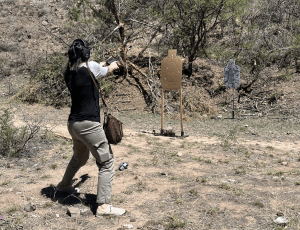
See Ways to Fight Tunneling In for more.
*****
Within Arms’ Reach
The second takeaway is about the plainclothes agent, who is following his trained reflex of reaching for his own gun in a gunfight (see image below).
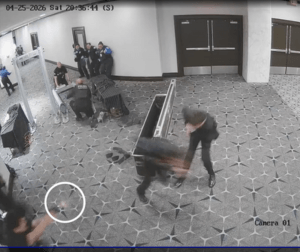
He backed away, and continued to back away, throughout his drawstroke. Distance favors the trained marksman, and we can assume he’d had better training than his opponent (lone wolf, wannabe assassins in America are usually not highly trained government agents, although some, like Mir Aimal Kansi, clearly had been trained, perhaps in terrorist training camps like the Paki platoon that attacked Mumbai).
But as I demonstrated to the house of worship security students, IF YOU ARE WITHIN A FOOT OF A KILLER WITH A LONG GUN, THE SAFEST PLACE IN THE ROOM FOR YOU TO BE IS IN A BEAR HUG WITH THE KILLER (that is, unless your partner is shooting at him). It’s faster than drawing a gun.
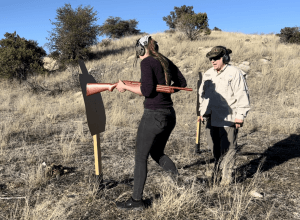
That close, your holstered gun will have ZERO effect on the outcome, unless you control the assailant’s weapons first.
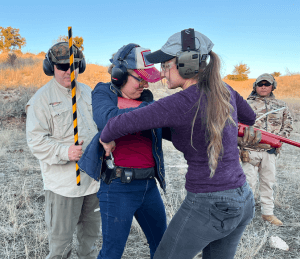
Unless you used to play rugby or (American) football, you probably have not trained to tackle people. As a wrestler, Jacob Ryker trained regularly to close with, grapple with, and body slam an opponent on the wrestling mat, and that skillset served Jake in good stead on the linoleum of the Thurston High School cafeteria.
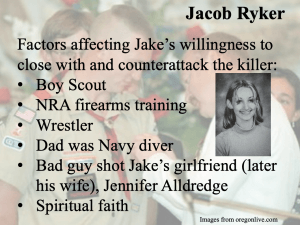
Its almost impossible to train in any survival skill too much, but it’s possible that Secret Service agent had trained too much to draw and fire his pistol, in proportion to his grappling training. I like to think that I’d have tackled the killer as he ran past, but I likely would have done the same thing as the plainclothes agent in these images. I, too, have trained a great deal more to draw and fire a pistol than I have to tackle people. I have actually tackled real suspects in the field (and played rugby), but not nearly as much as I have drawn and fired my pistols on firing ranges.
*****
Don’t Get Distracted From Your AOR
As everyone on scene got to the As of their OODA cycles, they all drew and ran after the suspect–almost completely abandoning their post. Not “abandoning” in the sense of running away in fear, but rather chasing after the shotgun toting suspect that they, too, got tunneled-in on.
One uniformed officer had the presence of mind to stay at that post, looking out, in case the guy who attacked their entry control point was only the first guy. The third lesson I wanted the security students to take away from our demonstration was that it’s OK to dispatch one or two people from other posts to help, but do NOT abandon your own post completely to help out others elsewhere who probably have things under control. That may be just what the bad guys want you to do.
As Ian pointed out, the Secret Service personnel manning that ECP were the best in the world at what they do: protective service. If it can happen to them, it can happen to us.
–George H, Special Agent (ret)