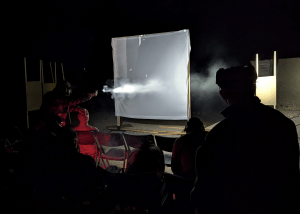
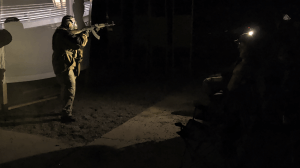
In the early 1980s, before SureFire made small, powerful flashlights mainstream, my boss who owned the Marksman Pistol Institute, an indoor range and training facility, got a call from the Tucson Police Department. They had responded to an alarm at night, and the exterior doors were both locked. They were wondering if anybody could have gotten in through the roof.
He linked up with the officers in the parking lot. They were concerned that their revolvers might be outgunned; a burglar in the lobby would have access to auto pistols, long guns, and a bunch of ammo. Their envy was somewhat transparent when my boss unlimbered his AR-180, with a powerful (for those days) 4 x D-cell Maglite mounted underneath the forearm, and began lighting up the roofline, helping the officers search for prowler(s).
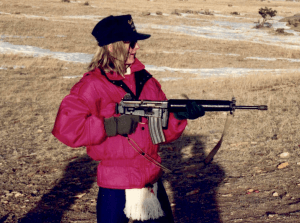
This Sterling AR-180 (without a light), and the lady shooting it, were both imports from England in the 1980s.
Light mounts were almost impossible to find for any weapons systems in the early ’80s, but my boss had fabricated the mount himself.
*****
Weapon Mounted Lights (WMLs)
A Weapon Mounted Light on a two-hand gun like a rifle or shotgun makes sense. Unless you have three hands, you’ll probably be in need of one sooner or later.
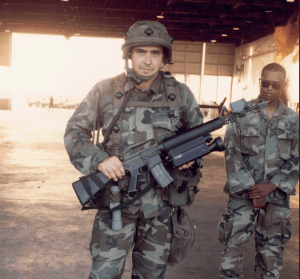
Early factory production WMLs were large, heavy, and unwieldy, even for long guns. This USAF security policeman sported a light and laser combo on his M16 at Davis Field, Oklahoma, during a JRTC exercise in 1992.
*****
Pistol Mounted Lights (PMLs)
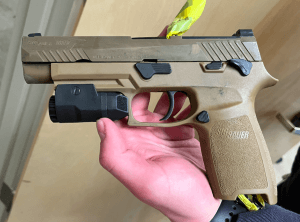
Pistol Mounted Lights are a subset of WMLs. They were developed for people in occupations where a handgun is a one-hand gun, rather than a handS gun; for example, K9 officers who often must have the other hand on a leash.
PMLS had some growing pains. Glocks are some of the most reliable autopistols ever made, but when people first started strapping lights onto them, they stiffened the frame they were attached to, limiting the “flex” (like one sees on the wings of a Boeing in flight) that was engineered into the system. This lack of flex, where flex was needed, sometimes adversely affected the firing cycle, and lead to stoppages. Subsequent “generations” of the Glocks were designed specifically to work with PMLs.
PMLs are now almost essential equipment on law enforcement duty pistols. While PMLs have “major cool factor,” there are those who think “civilians have no use for a PML.”
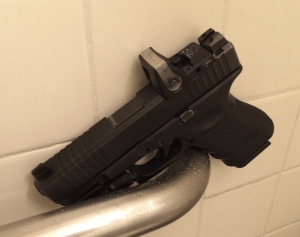
An unintended benefit: the PML makes this too wide to fall through the gap between the grab bar and the tile in this handicapped bathroom stall. With the RMR it could not be laid sideways on the grab bar, a safe alternative might’ve been to set it upside down on the floor.
I read in the January 2026 issue of Concealed Carry Magazine about a firearms instructor, Tom Givens, who has maintained a database of his students who were involved in gunfights. Most of their troubles occurred in transit outside their homes (67 of 74 incidents). Even though many incidents took place at night, none were in such absolute dark that the good guys needed a flashlight to identify their threats. Givens said:
“No one had a light attachment on their gun, and no one said they wished they had one. Flashlights on a carry gun away from home are just dead weight for civilians.”
–quoted by Mark Jacobs in “What Matters in a Gunfight,” CCM Vol 23 Issue 1 p. 82
Police PMLs
Givens specifically referenced civilians. A police officer’s authority to use deadly force is really no different from yours. The difference is, officers are paid to go looking for trouble, and to stick their noses in other people’s business, two pastimes armed civilians are best advised to avoid. WMLs on police pistols make sense because:
Hiding the gun is not an issue; uniformed officers in the USA carry openly (in contrast, most Bobbies in England are not armed, but the Bobbies who are carry concealed, so the crooks have to guess).
Cops spend a great deal of time hunting for people who are hiding, and who might very well ambush them (I know this from personal experience). A light is for searching, not shooting, but cops can get away with using a WML for searching, when the people they are looking for have been identified as threats by their own behavior.
Cases of mistaken identity (or misidentification of a weapon) in the dark have made for a great deal of case law. Short version, law enforcement agencies get sued for it. Law enforcement training places a great deal of emphasis on waiting for positive ID, something made easier by light.
When a SWAT team is flooding a house, they knock and announce first. Even with a “no knock” warrant (only slightly less uncommon than unicorn sightings these days), the people in the house will hear officers shouting “Police!” as soon as they have breached the door. The cops aren’t trying to hide in the dark. Everybody knows they are there. In those conditions, darkness in the friend of chaos, confusion, and criminals hiding, not the law. Warrant service teams often turn their WMLs on and leave them on throughout the initial clearing of the building.
PMLs are Secondary to Hand-Held Flashlights
At this point it is worth restating the obvious.
What a WML IS: a GUN with a light attached.
What a WML is NOT: a light with a gun attached.
A Cautionary Tale
Years ago, when PMLs were starting to become less uncommon on police pistols, I read about an officer who was writing a ticket at night. He was using his hand-held flashlight to get the VIN (vehicle ID number) off the dash in front of the driver, who was sitting in the driver’s seat. Naturally, Murphy struck and his batteries died when he was almost done getting the 17-digit alphanumeric sequence. Instead of going back to his car for another flashlight or more batteries (experienced officers keep spares in their car, and you should, too), he chose what Yoda called “the quick and easy path.” He pulled out this pistol and used the PML to get the last few digits. Forever did it dominate his destiny. The driver sued, and won.
Later, we were serving search and arrest warrants at a wheel shop that was a front for a meth distribution operation. I had started number two in the stack, but as we “flowed” through the various structures on the property, people would peel off to clear this room or that, two at a time. Some would stay with suspects they had apprehended. If your current room was clear, you rejoined the team, working forward in the main stack as others peeled off until it was your turn on another room.
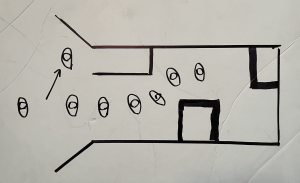
When we opened the doors to clear a long (trailer-sized) storage container out back, most of my team was ahead of me. The path between stacked items in the container started on the right side of the entrance but then wound left. I noticed a space in the pile to the left, just at the entrance, that could have had someone hiding in it. The other agents had bypassed it when we’d peeled open the doors. By the time I’d noticed it, though, the leading agents were beginning to wind around to the left behind it.
As my team moved deeper into a shipping container (from left to right in this crude diagram, which is not to scale), I spotted a potential hiding place off to our left (up in this illustration) and moved (arrow) to clear it . But by that time, leading elements of the entry team were on the other side of the hidey-hole, so I could not safely use a WML.
Kneeling down so I could see inside it, I kept my M4 in “rifle Sul,” and used a hand-held flashlight to check for bodies in that cubby hole with agents on the other side.
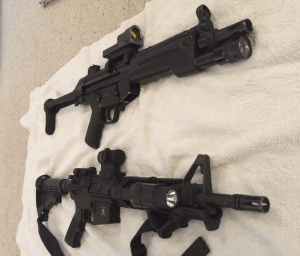
Both of these issued “long” guns had WMLs. I carried the M4 (bottom) on that wheel shop warrant.
A HAND-HELD light, or two (“two is one”) should be part of your EDC. Your cell phone light and your weapon mounted light (if any) should be considered secondary light sources.
Civilian PMLs
I am not opposed to pistol mounted lights on “civilian” carry pieces, because:
These days, there are several small, reliable, concealable, yet powerful enough pistol mounted lights on the market.
If you have a compact pistol, especially if you shoot a heavier cartridge like .40 or .45, the added weight under the front of the pistol is a bonus for recoil control.
If you need to use your pistol as an impact tool (say, it hiccuped at smell-his-breath range), a light that sticks out just a little farther than your slide will keep the slide from being pushed back when you strike, inducing a stoppage or turning a Type 1 stoppage into a Type 2 or 3.
PML as an Impact Tool
That latter may seem far-fetched, but not everybody who needs to be stopped RIGHT NOW can be shot.
Say, for example, you are taking cover behind a pillar with your pistol in hand in a very crowded mall, when suddenly the bad guy rounds the corner and he’s RIGHT THERE, within arms’ reach. You need to stop his rampage but there are too many innocents behind, and he’s so close that taking a knee to get a clear head shot will only get you shot execution style, or at best a leather sandwich in the teeth.
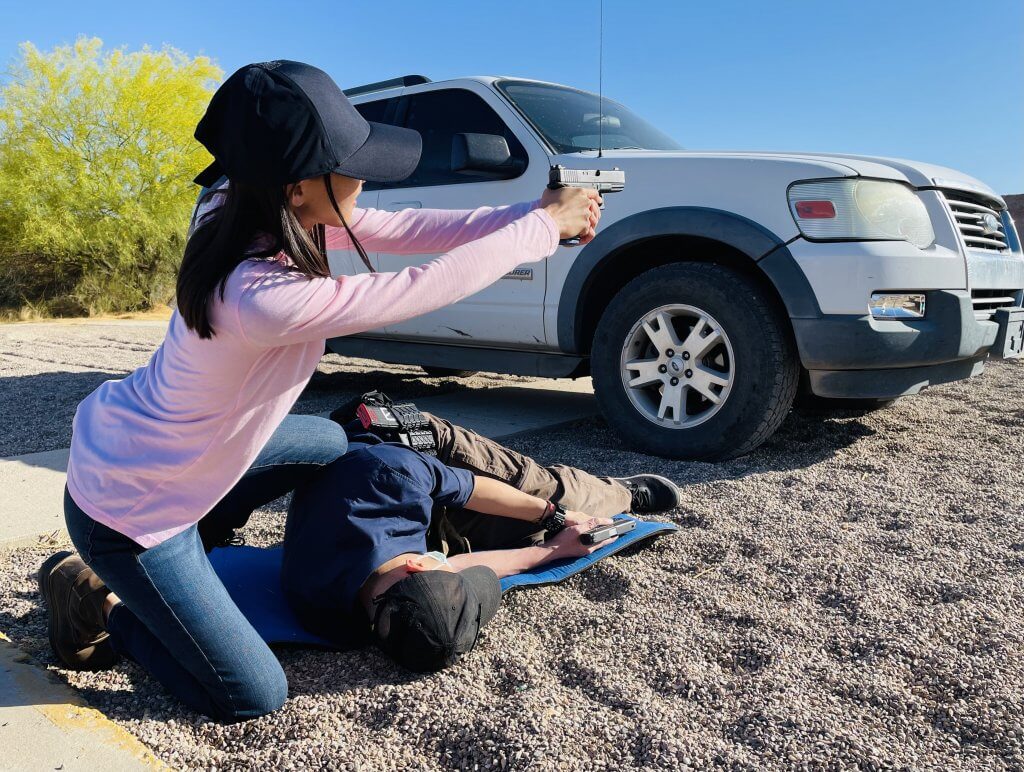
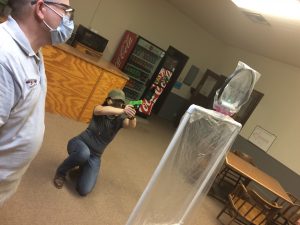
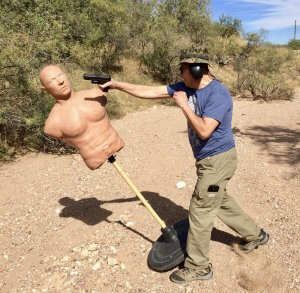
This demo with a laser-equipped PML was for safety education purposes. It works with cellophane bad guys, but it would be too close to a real bad guy to take a knee.
Gabe Suarez spoke of a domestic violence hostage situation he responded to. He was first in the stack, waiting outside the door for what seemed like hours. Suddenly the door flew open. The hostage taker stood in the doorway, gun in hand–but his kids were behind him. Gabe struck him hard between the eyes with his WML, knocking the hostage taker out cold. Problem solved.
You don’t NEED a PML to use a pistol as an an impact tool. It just helps.
All of those factors make the PML a nice to have, but not quite a NEED to have. I’ve pondered when one actually might NEED to have a PML.
Down to One Hand
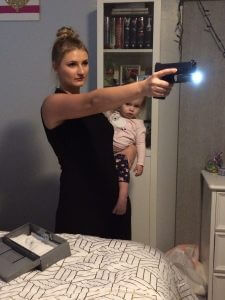
There are many situations when one might not have two hands free. You might be dragging a wounded partner, or carrying a child, or holding a cell phone.
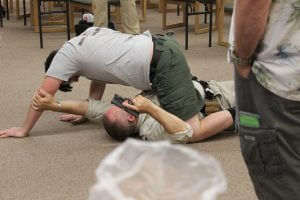
If you have one hand with a knife through it, like Heloderm Adjunct Instructor Ken S did once on the Ft Worth PD, you won’t need to use the light to repel boarders from a retention hold. The threat has pretty much identified himself by stabbing you, and since you are grappling with him, you won’t need a light to illuminate the iron sights (as in Neck Indexed) or to silhouette them. You won’t be using the sights when shooting from a retention position by your ribs.
If the guy on top was attacking you in the dark, you shouldn’t need the PML on that pistol to find, ID, or hit him–or would you? I got tackled by one of my partners in the dark, once. Verbal communication between us quickly cured the mistaken identity.
Active Killer in a Dark Theater
What if you are night-blinded by bright light in a dark room, specifically a movie theater, when a bad guy starts shooting from an even darker alcove to the side of the screen? That actually happened at the Century 16 in Aurora, Colorado, on 20 July 2012.
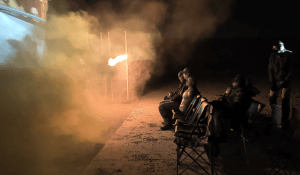
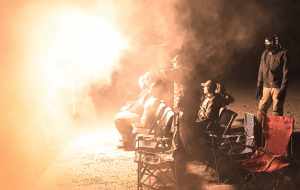
Like recording a strobe or flash of lightning with a timed exposure camera, this still from a video catches the bright illumination of the whole room at the moment of muzzle blast from blanks (aimed BESIDE the students, not AT them). Before and after each muzzle flash the environment was dark, except for on the movie screen, which mostly blinded the viewers to what was not on the screen.
Would a pistol mounted light be absolutely necessary, in that situation? Maybe not. But a PML could provide some tactical and some MORAL advantages:
The killer was wearing body armor. Shooting back at muzzle flashes alone, without illuminating the threat, would not allow you to see the armor and then to adjust your aim for pelvic or head shots.
The audience in the theater were confused and terror-stricken. A flashlight illuminating the bad guy lets everybody see exactly what they are facing. While that may not help with the terror, it certainly helps with the confusion.
Pointing a pistol mounted light at a bad guy as you shoot back clearly identifies you to the audience as a good guy trying to solve the problem, rather than an accomplice in a coordinated (more than one bad guy) attack, like at Columbine, San Bernardino, and STEM School Highlands Ranch. As more and more people are coming to the realization that the only way to keep the body count low during spree violence is to immediately counterattack the killer, clearly identifying yourself as a good guy trying to save them should keep you from being tackled by the crowd around you.
IFF: “Blue!”
When I teach officers and civilians to respond to spree violence, I have them yell “Blue! Blue!” specifically for IFF: Identification, Friend or Foe. In copspeak, “Blue” says “I’m a good guy.” A responsibly armed citizen yelling “Blue!” does NOT specifically and unlawfully impersonate an officer of the law. A civilian yelling “Police!” when they are not could get them arrested on the scene and / or could cause some sticky legal issues later.
Jay O, an instructor for Crosswalk Readiness, points out correctly that most civilians probably wouldn’t know what “blue” means. That is true, but they are not the intended audience. “Blue!” should be recognized by any off-duty cops in the crowd, or by any responding officers. THEY are the intended audience. “Blue!” should also be recognized by any military or former military in the crowd who are carrying concealed.
Concealed carry hero Johnny Hurley, who put down a cop killer, was probably NOT yelling “Blue!” when he was shot by responding officers as he moved the killer’s AR away from the bad guy he’d just shot. Hurley was hit by a police patrol rifle from some distance away, so verbalization may or may not have saved him, but the principle that proper verbalization can save your life is true and sound.
Downsides of Lighting Up
There are two distinct DISadvantages of a flashlight in an Aurora-type theater scenario:
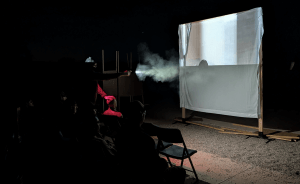
The Century 16 killer threw a CS (irritant gas) grenade into the auditorium. A bright light can bounce off of smoke just like bright headlights off of fog.
A student with a PML on an Airsoft pistol returns fire during a Heloderm theater shooting exercise
A lit flashlight can be, in Navy SEAL Jeff Gonzales’ words, “a runway for incoming rounds.” Bad guys do shoot at lights. A light may make it harder for him to see, but it won’t turn him into stone like a glance at Medusa.
Tactically, drawing fire is a distinct DISadvantage. MORALLY, it is exactly what we, as rescuers, want in an active violence situation. Bullets directed our way are not directed at children in the crowd. Yet another reason to stand up and yell “Blue!” Be assured the bad guy can figure out what that means. Manfred von Richthofen didn’t paint his Fokker bright red so he could avoid being noticed.
OK, so a flashlight can be advantageous. By why a Pistol Mounted Light?
Why PMLs in a Theater Environment
The good news for you the rescuer is, most people confronted with sudden, startling violence will instinctively crouch down. That won’t save them if a rescuer is NOT there, but it keeps them out of your line of fire.
Training with Airsoft to respond to spree violence in a dark theater. This Heloderm student has a hand-held light.
The bad news is, others in the theater will stand to run away. Murphy says they will stand up directly into the rescuer’s line of fire.
Flee vs Freeze
In Aurora, the vast majority of the patrons in the theater evacuated (see below). For those in Auditorium 9, the reason was obvious: they were trying to breathe. The killer had tossed an irritant gas canister.
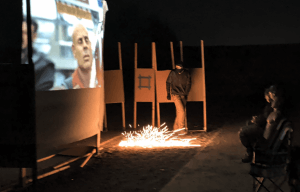
When the pin is pulled, the spoon flips off, and the igniter “pops,” an irritant canister (“tear gas grenade”) will generate a fountain of sparks before the smoke begins to billow.
The killer later said he had planned to herd his victims toward the exit. This was in sharp contrast to other mass murderers. At Platte Canyon High School, the Nickel Mines School, and Virginia Tech, the killers had locked their victims in to trap them.
But the Aurora Century 16 killer said what he feared most was being swarmed and counterattacked by his intended victims, who outnumbered him about 400 to 1. He intentionally attacked from the corner opposite the main entrance, which he described as a “pressure release valve,” to drive his victims toward the lobby door (Dr. William H. Reid, A Dark Night in Aurora, p. 121).
Spree killers vastly prefer shooting people in the back to facing a human wave counterattacking in “direct frontal assault” mode. See Isandhlwana and the Pulse Nightclub for more on swarming.
Absent a chemical irritant in the air, most intended victims will probably crouch or lie down, at least at first. But only most.
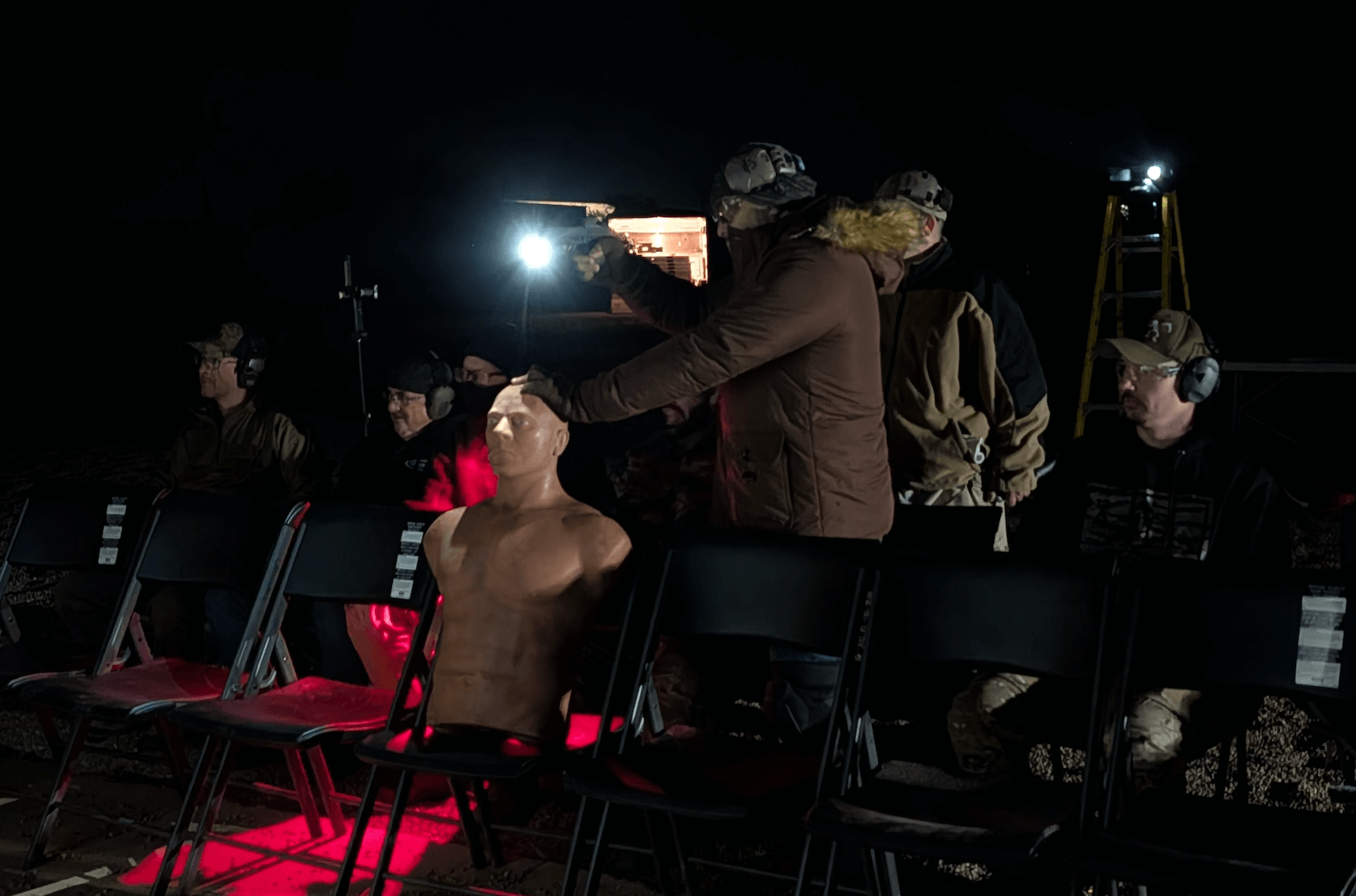
When training responsibly armed citizens to respond to lethal violence in a theater, we have you put your support hand on the person in front of you, pushing down, to keep them from standing up into your line of fire. That leaves you with only one hand for the pistol and any pistol mounted light.
When we train this with live fire, only a manikin sits in the front row. Target is off to the (audience’s) right of the screen, where the Aurora killer re-entered the theater. PML activated by shooting hand enables positive identification.
You must be able to operate a Pistol Mounted Light one-handed–otherwise, what would be the point of it being mounted on your pistol? Remember, PMLs were originally intended for operators who needed the support hand for something else.
*****
Before a Shooting
Darkness MAY be Your Friend
In much of my night pistol training (at Gunsite, Front Sight, and several other schools) the general mantra was “Light on, Shoot, Light off, Move.” Key word in the previous sentence: training. Here are some situations where we might try (with mixed success) to match those habits formed in training to our real-life operating environment.
Escape & Evasion (E&E)
Say you and your date are out to dinner when there is a power outage. The restaurant compensates with the romantic ambience of candles. But then there is a civil disturbance like mass smash ‘n’ grab looting nearby. You pay your check with cash and leave, trying to get back to your car and away from the entertainment district before things get too out of hand. The street lights aren’t working any more than the credit card machine in the restaurant did. When you think you see somebody who might be a threat crouching in the shadows, you would well be advised to light up your flashlight, scan, and then (if whatever you thought you saw turns out to not be a threat) turn the light off, and move on.
Not too different from typical low light range training, except you haven’t shot anybody (yet).
Wait til you detect another potential threat before lighting up your flashlight again. Walking around with a constantly lit beacon is not conducive to escape and evasion in the dark.
When you are in E&E mode, darkness IS your friend.
Barricading on Your Own Turf
Light management can be useful when defending against home invasion.
If a bad guy has broken into your home, you might best be advised to lock intervening barriers and leave the lights off. Account for everyone in your family, arm up, armor up if possible, and call 911. Wait to ambush the home invader when he breaches your bedroom door.
In such a situation I will be positioned in the most exposed position of the room, saving the better covered / concealed positions for my wife and kids. IF anybody uses a light, it will be me, to blind the home invader, and to draw fire away from my family.
In such a static situation, you could also pre-position a bright flashlight pointed at the door, say on the other end of the mattress, away from you and all other members of your family.
In the iconic Dirty Harry “211 in progress” scene, Clint Eastwood told Albert Popwell, “Well, to tell you the truth, in all this excitement, I kinda lost track myself . . .”
Popwell, who played the hapless wounded bank robber, replied, “Hey . . . I gots to know.”
If you just had to return fire at a bad guy, you will have to know the answers to these three questions, as well:
Is he down?
Is he staying down?
Does he have any friends?
The reality is, if you just had to shoot someone, which is what we are ostensibly practicing for in live fire training courses, turning off the light will night-blind you in the presence of your enemies. You will lose what little situational awareness you had gleaned from your snapshot of whatever was in the narrow beam of that flashlight before you turned it off.
In the so-called “fight or flight” reaction, your synapses will be firing faster, and your brain will feel starved for information.
Depending on your ammo and your barrel (especially if you have a “carry comp” that deflects burning gasses upwards to reduce muzzle flip), you may be extra-blinded by muzzle flash. Some quality defensive ammo has flash suppressant in the powder, but only some.
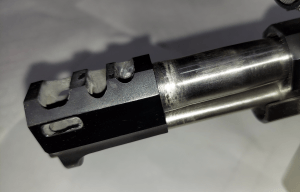
Vented-barrel muzzle compensators are great on a competition pistol, but I would avoid them on a carry piece. For one thing, I don’t want to get burned firing from a retention hold. Plus, they night-blind you even more than regular muzzle flash.
Bad guys do shoot at lights. Darkness is your friend if you are trying to break contact (get away).
In certain locations–say, a dark alley outdoors–immediately after you’ve traded bullets with someone, it might be a good idea to kill the light (first), then move to cover behind a dumpster or parked car.
That option may not be available if you are stuck in the middle of a theater full of frightened moviegoers.
“Fairchild–Six, shots fired I took him down he’s down this is Police Six he’s down!”
–USAF Security Policeman Andy Brown, 20 June 1994
Regardless of the environment, and whether or not you can get to cover, if you can’t escape, you still gots to know. After checking on the bad guy–again–scan the environment 360 degrees around you for any of his accomplices.
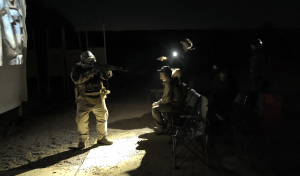
With a PML in a crowded theater, you might be advised to go to an upward pointing ready like Temple Indexed or “Sabrina,” with the light still on. This points the light at the ceiling, which should give you some reflected light in the room without lasering (pointing your muzzle at) all and sundry around you.
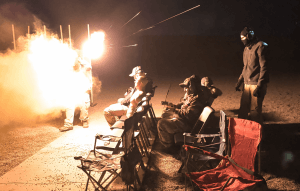
With the “outdoor theater” we used for the training in these photos, there was no ceiling except the sky and stars, so the light could not reflect off of it. The upward pointing ready kept this student from muzzling other students while turning to scan for additional threats.
Turn Toward Your Support Side when Scanning
When scanning for additional threats, it’s usually a good idea to turn around toward your support side, away from the pistol, all the more so with upward pointing readies. When holding a pistol in your dominant hand, it’s easier to pick up (point the pistol at) threats off to your support side. With the gun held in front of your body with two hands, it tends to point away from the dominant side. Threats toward your dominant (gun hand) side would have to be picked up one handed, at least at first.
Both of these training partners are right handed. It’s easier for the partner in white to pick up (acquire and engage) threats to her left than for the partner in black to pick up threats to her right.
With upward pointing readies, the pistol, your hand, and / or your arm block much of your view to the dominant side.
If any new threats you encounter get within arms’ reach, it is easier to defend against an off-line or gun grab if your support hand is closer to them. Turning the other way, a close attacker can easily off-line your pistol from outside your arm. It sets you up to be taken down with an arm bar.
For all the above reasons, a right-handed person should default to turning left when scanning for additional threats.
*****
Lock-Out Feature a PML Must Have
Some people think you cannot have too bright of a light. Some think a medium amount of light will get the job done without blinding you. Some want the ability to quickly and easily detach the light from the pistol. Some only want to buy American-made products. Several PML features are a nice to have, or a matter of personal preference. But one is absolutely necessary.
Regardless of which PML you choose or why, make sure it has a locking feature.
External manual safety selectors are a vestigial remnant of ancient times, and are unnecessary on a modern, striker-fired pistol. External manual safeties make the gun neither idiot-proof nor safe. In contrast, a “safety” on you PML is essential equipment.
The holster and trigger guard protect the trigger of a pistol, which usually takes 4+ pounds of pressure to move to the rear. Lights, on the other hand, take much less pressure, move or rock in different directions, and can often be pressed on from the side, well outside the trigger guard. When you set your pistol on its side in a safe, you need some way of keeping it from turning on the light accidentally. If it stays on, it could cause a fire–lithium batteries have their own fuel and oxidizer–and at the very least, your batteries will run out of charge.
This is a robust light, handy and small (and expensive). But it does NOT have a lockout feature I’m aware of, other than to unscrew and remove the battery.
Some “lockout switches” involve rotating the bezel on the front of the light. These are simple and effective but care must be exercised when manipulating them, as they will be near the muzzle of your pistol.
The trigger of this M18 is activated by pulling it to the rear, but the paddle switches on this PML are activated by pressing in from the sides. When stored in an alert condition, one must unscrew the bezel (ring around the light end) about a quarter of a turn, till the light is locked off. For long-term storage, remove any batteries.
But what if the light is locked in the “off” position when I need it? you may ask. As a general rule, if you know you need the gun right now, you don’t need the light. Lights are for brewing, or potential, fights, as opposed to flash fights.
During a break-in, after everyone in your home is accounted for, armed, and if possible armored up, and 911 has been called, you will probably have time to crank that PML into off-safe mode. If you’re almost certain it was the cat that knocked over the vase, and you can’t go back to sleep until you’re sure it was the cat, get the PML in working order before you leave your room to investigate.
If you are indoors and need illumination, don’t forget you can simply turn on the lights.
If you can’t turn on the lights–maybe hostile forces have killed the power, like in the movies–a PML might be useful.
*****
Don’t Try This at Home, Kids
CAUTION: The type of training pictured here should not be attempted without qualified, professional supervision. Special safety procedures are necessary for HTE and for using blanks.
Blank Safety
For example, with blanks, Heloderm uses two-factor authentication to ensure only blanks get into blank guns:
One authenticator pulls each blank out of the package and checks to ensure that individual cartridge is a blank (in the case of our Brown Bear 7.72x39mm blanks, by checking the lacquered star crimp) before handing it to the second authenticator.
The second authenticator then checks each cartridge handed to them before inserting it into a magazine that was completely empty beforehand.
This is one way to prevent what happened to Halna Hutchins and Joel Souza on the set of Rust near La Cienega, New Mexico.
Another is to not point a blank firing gun directly at anyone. While it may be necessary during military training, or perhaps even for cinematography (one assumes Alec Baldwin was pointing it at the camera on the direction of Hutchins, the cinematographer), one should never point a blank-adapted, blank firing gun directly at anyone nearby. The “Hollywood” blank firing adapter (BFA) we were using spits fire like a dragon. We used it specifically for the stress inoculation effect of realistic experience fragment training.
Student in second row has his Airsoft pistol with PML out. Range Safety Officer is standing behind the students. Bad guy role player is pointing off to the RSO’s left, and above the students.
Even old-style “box” BFAs spit fire.
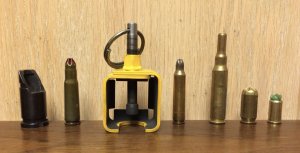
L to R: “Hollywood” blank adapter mimicking an AKM slant brake, 7.62x39mm blank, box BFA for AR series rifles, 5.56x45mm blank, 7.62x51mm (NATO) blank, .45 ACP blank, .38 blank
What may appear to be aiming at in these photos is actually aiming off to the side, or in some cases above, the students. I was attempting to replicate what the actual Century 16 shooter in Aurora did without endangering the students.
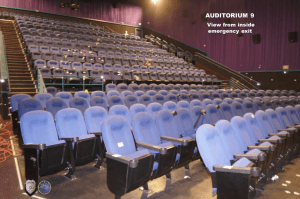
The actual auditorium where the massacre took place, from about where the killer started shooting. In our simulation, the students were in the front center section, and I was aiming at notional victims to the left of or in the stadium seating above and behind them, as I paced up the aisle on the left (from this perspective) and in front of the screen, which is what the killer did. Image from page 11 of System Planning Corporation’s (TriData Division’s) After Action Report for the City of Aurora on the Century 16 Theater Shooting of 20 July 2012
See Mind the Gas Port for more information about BFAs and blank safety.
*****
Airsoft HTE Safety
Every year, some cop (sometimes more than one) gets smoked in HTE training, when a live weapon sneaks its way in. It is vitally important in HTE training to screen for live weapons and ammo. The 3 layers of HTE / Airsoft safety are:
Self-screening
Buddy-frisking
Safety Officer checks
In addition, human targets / role players on the receiving end of Airsoft, UTM, Simunition FX, or other marking / less lethal cartridges should wear appropriate protection, including:
Neck protection
Hand protection (these should be thin and close fitting so as not to induce stoppages with Airsoft pistols)
Groin protection
Face protection–NOT just safety glasses
“Wraparound” sunglasses alone in paint pellet training cost Navy SEAL Adam Brown his right eye (Blehm, Fearless, pages 132 and 195 – 96)
A memorial for him on the Adam Brown Range at Thunder Ranch in Oregon
*****
When we conduct these theater scenarios with live fire, the target is a piece of cardboard, and the firing line is the second row. THERE ARE NO HUMANS IN THE FRONT ROW. This keeps us from lasering anybody during the draw stroke. The trainee places their hand on the head of a manikin (only) in the front row, as if keeping the manikin from standing up into the line of fire. One handed operation is the main advantage of a pistol mounted light.
The real lesson of the Century 16 theater massacre of 20 July 2012 was not about PMLs. It was about fighting back.
Most of the audience started to flee once they understood the shooting to be real. . .
Video of the early moments of the exodus show a scene that was less panic than rapid movement of people who were clearly scared and shocked. Some held doors open for others. Some assisted those who were hurt, in shock, or just upset. Most of the audience was young and in reasonably good physical condition. Few seemed to fall or stumble; no one was injured by trampling or by others fleeing, to everyone’s credit. . .
Several moviegoers acted heroically. Three of the 12 victims killed were young men who gave up their lives, shielding friends sitting near them.
Rather than rushing out, several people in the audience in Theater 9 took cover, getting low behind seats to get out of the line of fire. No one in the theater other than the shooter was found to have been armed. No one attempted to attack the shooter.
70 people were shot in the Century 16 Theater of Aurora. Seventy. 12 died.
Contrast that with the 12 Mar 2026 attack on the ROTC detachment at Old Dominion University. One (detachment commander LTCOL Brandon Shah) was killed and two wounded–ONLY–because the ROTC cadets fought back, hand-to-hand.
After concluding the attacker was in no condition to be interrogated, the Special Agent in Charge of the Norfolk FBI field office, Dominique Evans, said that the ROTC cadets showed “extreme bravery and courage” by fighting back and subduing him. They “rendered him no longer alive,” said Evans, deftly side-stepping stating conclusively how the killer got so mangled before the autopsy could be conducted. “I don’t know how else to say it.”
*****
Special thanks to Jay O of Crosswalk Readiness, without whom the “outdoor theater” environment we set up to train with PMLs in these photos would not have been possible.